


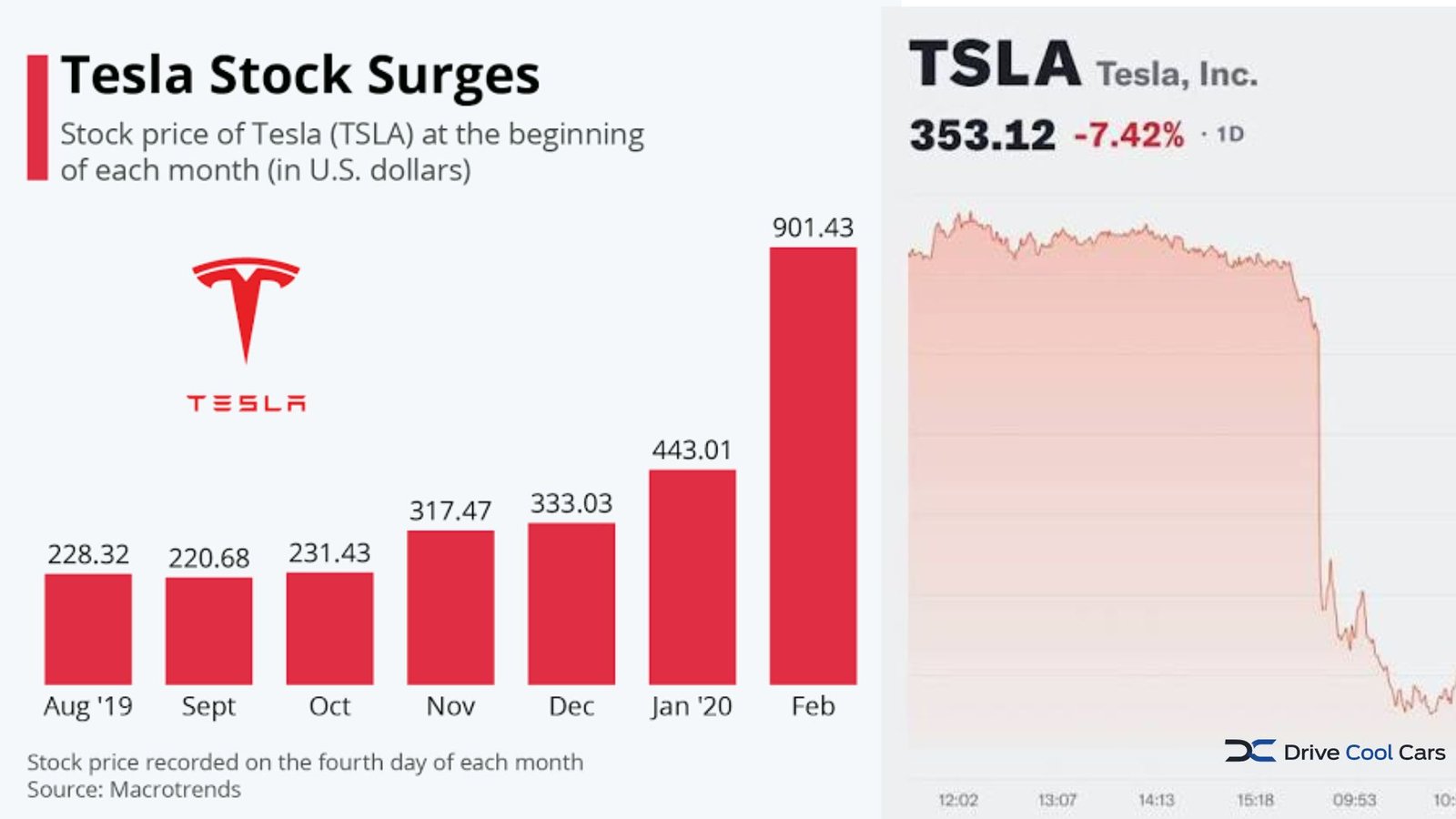
The Tesla stock price reflects far more than electric vehicle sales. Investors are also pricing in Tesla’s energy storage business, artificial intelligence ambitions, autonomous-driving technology, Robotaxi plans, manufacturing scale, and future product launches. That makes the shares unusually sensitive to both quarterly financial results and expectations about what the company could become.
For anyone tracking Tesla stock today, the key question is not simply whether the shares are rising or falling. It is whether Tesla’s operating performance is improving enough to justify the market’s expectations.
Tesla Stock Price: What Is Driving It?
Tesla trades on the Nasdaq under the ticker symbol TSLA. Its share price can move sharply after earnings announcements, delivery reports, product updates, regulatory developments, or changes in investor expectations.
The latest reported results provide useful context. In the second quarter of 2026, Tesla delivered 480,126 vehicles and produced 451,758. The company also deployed 13.5 GWh of energy storage products.
Tesla’s Q2 financial update showed $0.4 billion in GAAP operating income and $1.1 billion in GAAP net income. The company also reported $4.7 billion in operating cash flow and said trailing-twelve-month revenue had exceeded $100 billion for the first time.
These figures matter because the Tesla stock price ultimately depends on the relationship between business performance, future growth expectations, and the valuation investors are willing to pay.
Vehicle Sales Still Matter
Tesla remains heavily exposed to the global electric vehicle market. Vehicle deliveries influence revenue, factory utilisation, margins, cash generation, and investor sentiment.
However, deliveries alone cannot explain every movement in the shares. Tesla itself cautions that deliveries and energy deployments are only two measures of financial performance because average selling prices, production costs, foreign exchange movements, and other factors also affect quarterly results.
That is why investors should examine revenue, profitability and cash flow alongside delivery numbers.
The Bigger Tesla Investment Story
The most important distinction for investors is between Tesla’s current automotive business and its potential future businesses.
Tesla is investing heavily in artificial intelligence, autonomous driving, Robotaxi services, energy storage and new manufacturing capabilities. Its 2025 annual report identifies autonomous driving, AI capabilities, Cybercab, battery technology and energy products among its major strategic priorities.
The company has also begun production of Cybercab and reported the launch of its Robotaxi service in three Florida cities during July 2026.
If these businesses develop successfully, they could eventually influence how investors value Tesla. But there is a crucial distinction between an opportunity and an established source of earnings. Future products and services can support a higher valuation only if they eventually produce sustainable economic returns.
What Could Push the Shares Higher?
Several developments could improve sentiment around Tesla.
| Factor | Why investors may care |
|---|---|
| Vehicle deliveries | Higher volume can support revenue and factory utilisation |
| Automotive margins | Stronger margins can improve earnings quality |
| Energy storage | Expanding deployments diversify Tesla beyond vehicles |
| Robotaxi | Successful scaling could create a new mobility revenue stream |
| AI and autonomy | Progress could strengthen Tesla’s long-term growth narrative |
| Cash flow | Strong cash generation gives the company more flexibility for investment |
Energy is particularly relevant because Tesla’s 2025 energy generation and storage revenue increased 27% from the previous year to $12.77 billion, while automotive revenue declined 10% to $69.53 billion.
That contrast shows why investors increasingly look beyond vehicle sales when assessing the business.
💡 Pro Tip: When checking the Tesla stock price after a major announcement, compare the share move with the underlying numbers. A positive delivery surprise, for example, does not automatically mean profitability improved. Look at margins, cash flow and management’s outlook before interpreting the market reaction.
What Could Pressure Tesla Stock?
Tesla carries substantial execution risk. The company’s annual report highlights potential problems involving product launches, manufacturing costs, supply chains, autonomous-driving development, consumer demand, competition and regulation.
Competition is another major consideration. Electric vehicle markets are expanding, but Tesla competes with established automakers and newer EV manufacturers. Price reductions or increased incentives can support demand while simultaneously putting pressure on margins.
Regulation can also affect the investment case. Government incentives for electric vehicles, charging infrastructure and related technologies can change, while autonomous-driving systems face regulatory requirements that vary by jurisdiction.
The Tesla stock price can therefore respond not only to Tesla-specific news but also to interest rates, economic conditions, technology-sector sentiment and broader market risk appetite.
How Should Investors Evaluate Tesla?
A useful approach is to separate measurable performance from long-term expectations.
Start with the company’s quarterly reports. Check revenue growth, automotive gross margin, operating income, free cash flow and cash and investments. Then examine vehicle production and deliveries, energy-storage deployments, and changes in capital expenditure.
Tesla reported $94.83 billion of total revenue for 2025, down 3% from 2024. Net income attributable to common stockholders was $3.79 billion, while the company ended 2025 with $44.06 billion in cash and cash equivalents and investments.
Next, consider valuation. A company can have strong products and promising technology while still being expensive relative to its current earnings. Investors therefore need to decide how much future growth is already reflected in the share price.
For UK investors, currency also matters. A move in TSLA shares in U.S. dollars can produce a different return when translated into pounds because exchange rates affect the value of the investment.
For U.S. investors, the same principle applies in reverse when comparing Tesla with companies whose revenues or costs are more internationally diversified.
📌 Key Takeaway: The Tesla stock price should be assessed against Tesla’s earnings, cash flow, vehicle economics and future growth opportunities—not viewed as a standalone number. The strongest analysis separates today’s financial performance from assumptions about tomorrow’s technology businesses.
Frequently Asked Questions
What is Tesla’s stock ticker?
Tesla trades on the Nasdaq stock exchange under the ticker TSLA. Investors can use TSLA when searching for the company’s current market quote, historical performance, trading volume and other market information through their brokerage or financial-data provider.
Why is Tesla stock so volatile?
Tesla’s shares can be volatile because investors assign significant value to future growth as well as current automotive results. Earnings, deliveries, product announcements, autonomy developments, regulation, interest rates and broader technology-market sentiment can all change expectations quickly.
Does Tesla only make money from electric cars?
No. Tesla generates revenue from automotive activities, energy generation and storage, and services and other activities. Its energy-storage business has become increasingly significant, while services include areas such as Supercharging, insurance, used vehicles and maintenance-related activities.
Is Tesla stock suitable for long-term investors?
Suitability depends on an investor’s objectives, risk tolerance, valuation expectations and portfolio diversification. Tesla’s potential opportunities are substantial, but the company also identifies meaningful operational, competitive, regulatory and execution risks in its SEC filings. Investors should assess those risks rather than relying on a single price target.
Where can I check the latest Tesla stock price?
A live quote should be checked through a current market-data provider or brokerage because share prices change continuously during trading. Tesla’s official Investor Relations website is also useful for earnings releases, SEC filings, shareholder materials and company announcements.
Conclusion
The Tesla stock price is best understood as a market judgment about both Tesla’s present business and its expected future. Vehicle deliveries and margins remain fundamental, but energy storage, AI, autonomy and Robotaxi development increasingly shape the long-term investment narrative.
For investors in the U.S. or UK, the practical lesson is simple: follow the financial statements, compare operating progress with valuation, and treat ambitious future plans as possibilities rather than guaranteed earnings. That approach provides a more useful framework for interpreting every major move in Tesla shares.
