


Silicon photonics combines optical communication with semiconductor manufacturing to move data using light rather than relying entirely on electrical signals. The technology is especially important in data centers, where growing bandwidth demands are putting pressure on conventional electrical interconnects. For businesses and engineers, silicon photonics offers a practical route toward higher bandwidth, efficient connectivity, and tighter integration between optics and computing hardware.
What Is silicon photonics?
Silicon photonics is an integrated photonics technology that uses silicon-based chips to generate, guide, modulate, and detect optical signals. Instead of sending every high-speed signal as an electrical current through copper pathways, photonic systems encode information onto light and transmit it through optical fiber.
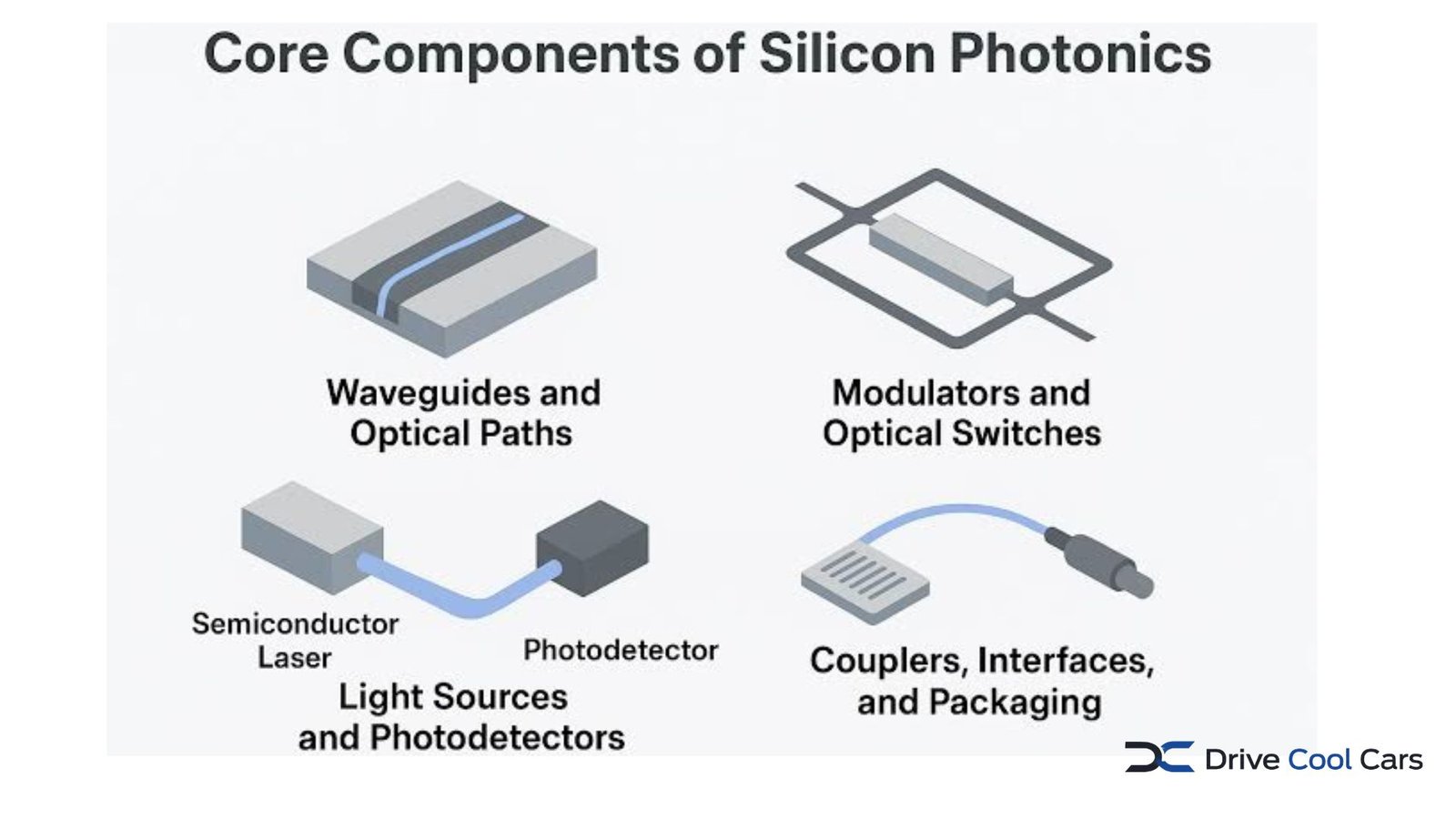
The approach takes advantage of silicon’s established semiconductor manufacturing ecosystem. Photonic integrated circuits can incorporate components such as waveguides, modulators, photodetectors, and optical coupling structures on a compact chip. Some systems also integrate lasers using additional semiconductor materials because silicon itself is not an efficient conventional laser material.
That distinction matters. Silicon provides an excellent manufacturing platform, but a complete optical system may require heterogeneous integration with materials such as III-V semiconductors for light generation.
How Does silicon photonics Work?
A typical optical link converts electrical data into an optical signal, sends that signal through a waveguide and fiber, and then converts it back into an electrical signal at the receiving end.
The process involves several key components:
- Laser: Provides the light source used to carry information.
- Modulator: Changes properties of the light to encode digital data.
- Waveguide: Directs light across the photonic chip.
- Photodetector: Converts incoming optical signals back into electrical signals.
- Electronic circuitry: Drives the optical components and processes the received data.
- Fiber coupling: Connects the chip’s optical path with external fiber.
Wavelength-division multiplexing can further increase capacity by transmitting multiple optical channels at different wavelengths through the same fiber. This makes photonic links particularly useful for high-density data-center connectivity.
The basic advantage is straightforward: light provides a high-bandwidth communication medium, while silicon manufacturing can help integrate many optical and electronic functions into compact hardware.
Why Is silicon photonics Important for Data Centers?
Data centers constantly move information between servers, switches, accelerators, storage systems, and other infrastructure. As computing workloads become more demanding, the amount of data that must move between these components also increases.
Electrical interconnects remain highly useful for short distances, but optical communication becomes increasingly attractive as bandwidth and reach requirements rise. Intel, for example, describes photonics as a way to address bandwidth, power, and scaling challenges in data-center I/O.
Current commercial platforms demonstrate how far the technology has progressed. Intel reports silicon photonics solutions supporting 400Gbps, 800Gbps, and 1.6Tbps connectivity, while its newer optical compute interconnect work targets multi-terabit-per-second connections.
| Area | Conventional Electrical Interconnect | Silicon Photonics |
|---|---|---|
| Signal medium | Electrical current | Optical signal |
| Typical transmission path | Copper traces/cables | Waveguides and optical fiber |
| High-bandwidth scaling | Increasingly challenging | Well suited to dense optical links |
| Long-distance connectivity | Higher signal-loss considerations | Strong fit for fiber-based links |
| Integration | Mature electronic ecosystem | Combines photonics with semiconductor processes |
| Main challenge | I/O power and signal integrity | Packaging, lasers, coupling, and manufacturing complexity |
💡 Pro Tip: When evaluating a photonic solution, look beyond headline bandwidth. Compare the complete link—including laser efficiency, electrical drivers, thermal requirements, fiber coupling, packaging, and optical loss—to understand its real system-level value.
Applications Beyond Data Centers
Although high-speed networking is one of its most established uses, silicon photonics has a broader role in integrated optics.
Telecommunications can use photonic integrated circuits for optical transmission and signal processing. Emerging computing architectures are also exploring optical I/O to move data between processors, memory, and other components more efficiently.
Research applications are expanding as well. NIST has demonstrated integrated photonic technologies for precision measurement, frequency-comb generation, quantum-related applications, and optical frequency systems.
Other potential applications include:
- LiDAR and optical sensing
- Biomedical and chemical sensing
- Quantum technologies
- High-performance computing
- Microwave and millimeter-wave signal generation
- Precision timing and metrology
These applications do not all use identical architectures. Some rely on silicon waveguides, while others combine silicon with silicon nitride, tantalum pentoxide, III-V materials, or other photonic platforms to obtain specific optical properties.
Advantages and Limitations
The strongest case for silicon photonics comes from integration. A large number of optical functions can be fabricated at chip scale, potentially reducing size and enabling semiconductor-style manufacturing and testing.
Its advantages include:
- High bandwidth potential
- Compact photonic integration
- Compatibility with established silicon manufacturing processes
- Efficient optical transmission over fiber
- Support for dense wavelength multiplexing
- Potential for closer optical-electronic integration
However, the technology is not simply a replacement for every electrical connection.
Laser integration remains a significant engineering issue because silicon is not naturally suited to conventional light generation. Researchers therefore use hybrid or heterogeneous approaches to combine silicon with other semiconductor materials. Packaging and fiber coupling also require precision, and thermal management can become important in densely integrated systems.
Cost advantages also depend on manufacturing volume and system design. A photonic chip may reduce some costs while introducing new requirements for optical assembly, testing, and packaging.
What Is the Future of silicon photonics?
The next stage is moving optics closer to the computing hardware itself. Rather than limiting optical links to connections between racks or switches, researchers and manufacturers are investigating optical I/O integrated with processors and other compute devices.
This direction is particularly relevant to AI and high-performance computing, where moving large quantities of data can become a major system constraint. Intel’s optical compute interconnect work illustrates this trend, with a stated path from multi-terabit connectivity toward much higher bandwidth at the device level.
The broader development of integrated photonics also points toward increasingly heterogeneous chips that combine electronics, optical components, lasers, detectors, and advanced packaging technologies.
📌 Key Takeaway: silicon photonics is not merely “faster fiber.” Its significance lies in bringing optical communication onto semiconductor platforms, allowing manufacturers to integrate light-based data movement with increasingly sophisticated electronic systems.
Frequently Asked Questions
Is silicon photonics faster than traditional electronics?
It can provide substantially higher bandwidth for appropriate optical links, particularly in data-center and telecommunications applications. The practical performance depends on the complete system, including modulation, wavelength multiplexing, fiber, electronics, packaging, and transmission distance rather than the photonic chip alone.
Why is silicon used in photonics?
Silicon is attractive because the semiconductor industry has highly developed processes for fabricating precise structures at scale. Silicon also supports compact optical waveguides and can be integrated with electronic circuitry. However, additional materials are often needed for functions such as efficient laser generation.
Is silicon photonics only used in data centers?
No. Data-center networking is a major commercial application, but integrated photonics is also being developed for telecommunications, sensing, quantum technologies, precision measurement, frequency generation, and advanced computing. NIST research demonstrates several of these broader applications.
What are the main challenges of silicon photonics?
Key challenges include integrating efficient light sources, coupling light between chips and fiber, managing thermal effects, packaging optical and electronic components, and maintaining manufacturing yields. System designers must also balance optical performance against cost, power consumption, and complexity.
Will photonics replace electronic chips?
Photonics is more likely to complement electronics than replace it entirely. Electronic circuits remain excellent for logic, memory, control, and many short-distance connections. Photonic technology is especially valuable for moving large amounts of information, making hybrid electronic-photonic architectures a more realistic direction.
Conclusion
silicon photonics has evolved from a specialized research area into an important technology for modern optical connectivity. Its combination of light-based communication, compact integration, and semiconductor manufacturing makes it particularly valuable as data movement becomes a larger part of computing infrastructure.
The most promising path is not optics versus electronics, but tighter cooperation between the two. As photonic components move closer to processors, switches, and other compute resources, silicon photonics could become an increasingly important foundation for high-bandwidth computing and communications.
