


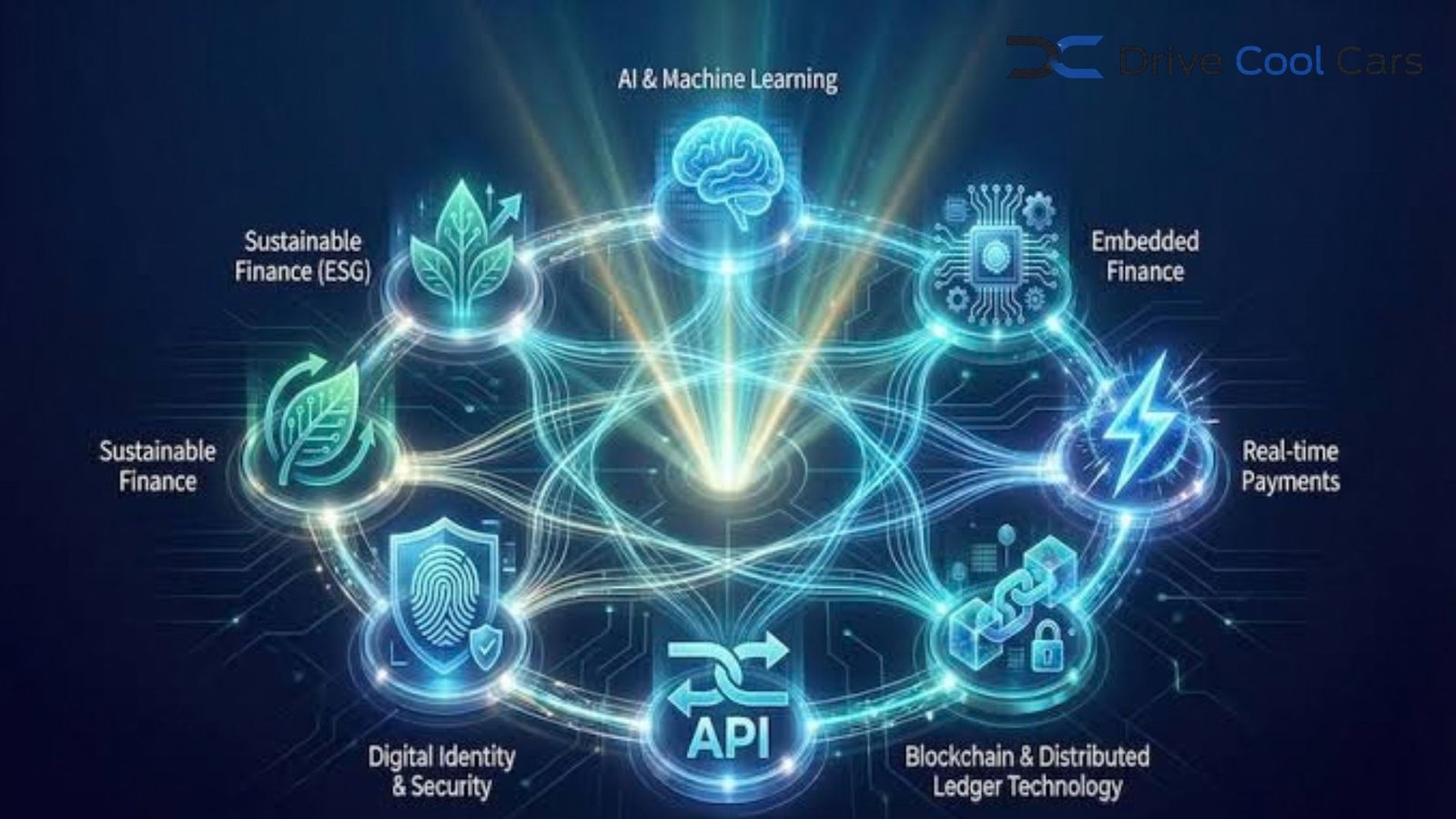
Fintech futures are moving beyond mobile banking and faster payments. The next phase of financial technology is being shaped by artificial intelligence, open banking, real-time payments, digital assets, embedded finance, and tighter expectations around security and consumer protection.
For businesses and consumers in the United States and United Kingdom, the key question is no longer simply what financial technology can do. It is how these technologies will change the way people borrow, save, invest, pay, and manage money while regulators work to keep innovation trustworthy.
What Are Fintech Futures?
The term fintech futures describes the likely direction of financial services as technology changes products, infrastructure, customer experiences, and business models.
The shift is already visible. The UK’s Financial Conduct Authority (FCA) reports more than 16 million active open-banking users and 53% year-on-year growth in open-banking payments during 2025.
In the US, pay-by-bank and account-to-account payments are receiving increasing attention as alternatives to conventional card-based transactions. A Federal Reserve analysis highlights potential benefits as well as adoption, security, and consumer-behaviour considerations.
These developments suggest that fintech is becoming less about individual apps and more about the underlying financial infrastructure.
The Major Forces Behind Fintech Futures
Several technologies are likely to influence financial services over the coming years.
| Trend | What it changes | Main consideration |
|---|---|---|
| Artificial intelligence | Fraud detection, support, underwriting and personalised services | Governance and accuracy |
| Open banking and open finance | Secure data sharing and account-to-account payments | Consent and data security |
| Instant payments | Faster movement of money | Fraud prevention |
| Digital assets | New forms of payment and investment infrastructure | Regulatory clarity |
| Embedded finance | Financial services inside non-financial products | Consumer protection |
Artificial Intelligence Moves Into Financial Workflows
AI is becoming one of the most significant forces shaping fintech futures. Financial firms can use it for customer service, document analysis, fraud monitoring, risk assessment, and operational processes.
The FCA’s 2026 review identified four major AI-driven shifts: changes to firm operations, evolving customer journeys, changing competition and market power, and increased fraud and cyber risks.
The opportunity is substantial, but financial AI requires strong controls. A flawed automated decision can affect access to credit, insurance, investments, or other essential services. The FCA says firms using AI should continue to meet existing expectations around governance, consumer protection, and senior management responsibility.
Open Banking Is Expanding Toward Open Finance
Open banking allows customers to give trusted services access to certain banking information or payment capabilities. Open finance extends this principle into areas such as mortgages, pensions, investments, insurance, and credit.
This expansion could make financial products more personalised because providers can work with broader, consented financial information.
The UK is already developing its next stage. In 2026, the FCA published an open-finance roadmap and said it would explore practical applications including better access to credit for small and medium-sized businesses and improved mortgage processes.
💡 Pro Tip: For any fintech product that relies on financial data, design the consent experience as carefully as the core feature. Users should understand what data is being shared, why it is needed, and how they can withdraw permission.
Payments Are Becoming More Direct
Payment infrastructure is another important part of fintech futures. Account-to-account payments can reduce dependence on traditional payment rails in certain use cases and create new options for merchants and consumers.
In the UK, commercial variable recurring payments are being developed to give customers more flexible ways to authorise recurring transactions. The FCA expects the new framework to support greater choice while maintaining safeguards around security, fraud, and consumer protection.
The US market is developing differently, but pay-by-bank is also attracting attention. The Federal Reserve describes it as an emerging payment method in which money moves directly from the payer’s bank account to the payee.
The broader trend is clear: payment experiences are increasingly being built around speed, interoperability, convenience, and direct connectivity between accounts.
Regulation Will Shape the Next Wave
Technology alone will not determine fintech futures. Regulation will influence which products can scale, how firms manage risk, and how consumers are protected.
The FCA’s 2026/27 work programme includes initiatives covering open banking, open finance, stablecoins, fund tokenisation, AI testing, and consumer protection.
That environment creates a practical lesson for fintech companies: regulatory planning should happen during product development rather than after launch.
The FCA’s 2025 innovation analysis also found that fintech firms are seeking regulatory clarity earlier as technologies become more sophisticated. Its analysis reported that global fintech investment exceeded $130 billion across more than 4,500 deals in 2025, while UK fintech companies accounted for $15 billion in disclosed investment across 445 deals.
What Fintech Companies Should Prepare For
Companies planning around fintech futures should concentrate on fundamentals rather than chasing every emerging technology.
Three priorities stand out:
- Trust: Clear permissions, transparent pricing, strong security, and dependable customer support.
- Interoperability: Products should connect effectively with banks, payment systems, data providers, and other financial infrastructure.
- Responsible automation: AI should have appropriate oversight, testing, monitoring, and human accountability where decisions carry significant consequences.
Fintech businesses also need to consider resilience. A product that works well under normal conditions must remain reliable during fraud attempts, system outages, unexpected demand, and regulatory changes.
The US and UK Are Taking Different Paths
The two markets share many technological trends, but their regulatory and infrastructure environments differ.
The UK has developed a mature open-banking ecosystem and is now working toward broader open finance. The US has a large and diverse financial system in which payment innovation, bank connectivity, and emerging fintech models are developing across multiple institutions and providers.
For companies operating internationally, copying a product model from one market into the other may therefore create unnecessary regulatory and operational risks.
📌 Key Takeaway: The strongest fintech opportunities are increasingly found where technology, financial infrastructure, and responsible regulation intersect. Innovation needs to solve a real customer problem while earning trust.
Frequently Asked Questions
What are the biggest fintech trends for 2026?
Artificial intelligence, open finance, account-to-account payments, embedded financial services, digital assets, and fraud technology are among the major areas receiving attention. Regulation and cybersecurity are equally important because they determine how safely these technologies can be deployed at scale.
How will AI affect financial services?
AI can automate administrative work, analyse documents, support customer interactions, detect suspicious activity, and assist certain financial decisions. Its risks include inaccurate outputs, poor governance, cybersecurity threats, and inappropriate automated decisions, making oversight essential.
What is the difference between open banking and open finance?
Open banking primarily concerns access to banking data and payment services through regulated connections. Open finance expands the concept to additional financial products, potentially including pensions, mortgages, investments, insurance, and credit.
Are fintech companies replacing traditional banks?
Fintech companies are not simply replacing banks. Many are partnering with banks, payment providers, technology companies, and other financial institutions. The industry is increasingly characterised by collaboration, specialised technology, and competition across individual parts of the financial-services value chain.
Why is cybersecurity important for fintech?
Fintech products handle sensitive financial information and transactions, making them attractive targets for fraud and cyberattacks. Strong authentication, monitoring, secure data practices, incident response, and ongoing risk management are therefore central to sustainable fintech growth.
Conclusion
Fintech futures will be defined less by novelty and more by useful infrastructure. AI can make financial services more responsive, open finance can connect previously fragmented financial information, and new payment methods can create additional choices for businesses and consumers.
The companies that navigate this next stage will need more than sophisticated technology. They will need reliable systems, transparent customer experiences, strong security, and a clear understanding of regulatory responsibilities. That combination will determine how financial innovation develops across the US, UK, and the wider global market.
