


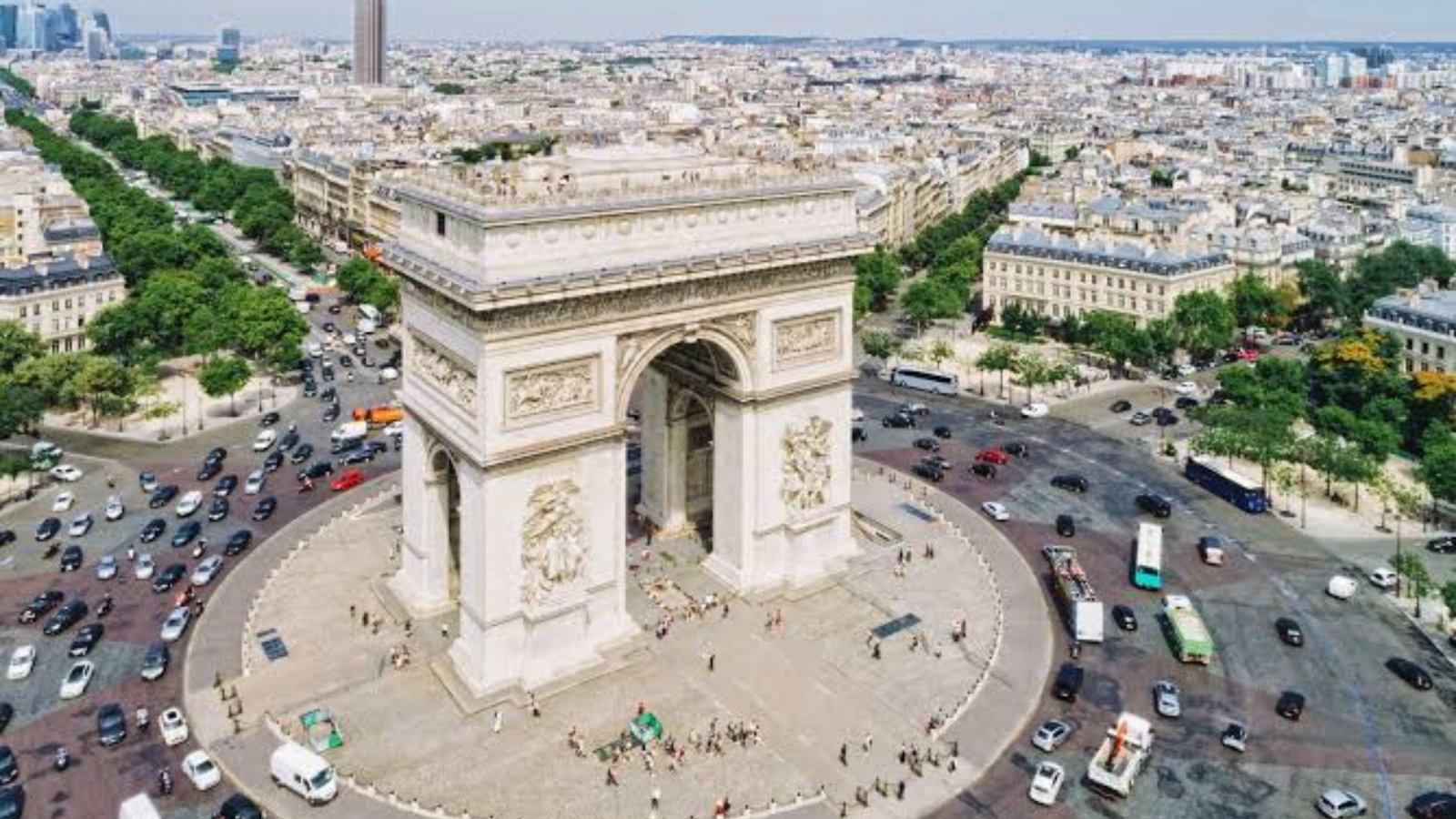
Paris has many famous landmarks, but few carry as much history as the Arc de Triomphe. First-time visitors often struggle to understand its meaning, find the correct entrance, or decide whether rooftop tickets are worth buying. Missing these details can lead to wasted time and an incomplete experience. This guide explains the monument’s fascinating history, architecture, ticket prices, visiting hours, and practical travel tips.
What Is the Arc de Triomphe?
The Arc de Triomphe is a monumental triumphal arch in Paris, France. Napoleon Bonaparte commissioned it in 1806 to honor French military victories and the soldiers who served in France’s armies.
The structure stands at the western end of the famous Champs-Élysées. Today, it represents French history, national remembrance, and architectural achievement.
Its name translates to “Arch of Triumph” in English.
Unlike a palace or museum built mainly for displaying collections, this landmark began as a public monument celebrating military achievements. Over time, its meaning expanded to include remembrance of those who died in war.
Visitors can admire its enormous stone sculptures, explore a small exhibition inside, and climb to a panoramic terrace overlooking central Paris.
Arc de Triomphe Paris: Quick Facts and Essential Information
Here is a detailed overview of the monument’s most important features.
| Feature | Details |
|---|---|
| Official name | Arc de Triomphe de l’Étoile |
| Location | Place Charles de Gaulle, Paris, France |
| Country | France |
| Commissioned by | Napoleon Bonaparte |
| Construction began | 1806 |
| Completed | 1836 |
| Main architect | Jean-François-Thérèse Chalgrin |
| Architectural style | Neoclassical |
| Monument height | Approximately 50 meters (164 feet) |
| Monument width | Approximately 45 meters (148 feet) |
| Monument depth | Approximately 22 meters (72 feet) |
| Construction period | Approximately 30 years |
| Main construction material | Limestone |
| Number of radiating avenues | 12 |
| Steps to rooftop | 284 |
| Main attraction | 360-degree panoramic terrace |
| Memorial | Tomb of the Unknown Soldier |
| Eternal Flame first lit | November 11, 1923 |
| Nearest Metro station | Charles de Gaulle–Étoile |
| Recommended visit duration | 45–90 minutes |
| Adult admission | Seasonally €16–€22, subject to eligibility and changes |
| Monument management | Centre des monuments nationaux |
The arch is both a historical memorial and a popular observation point. Its central location makes it particularly convenient for travelers exploring western Paris.
Where Is the Arc de Triomphe Located?
The monument stands in Place Charles de Gaulle, formerly called Place de l’Étoile, in the western part of central Paris.
Its address is:
Place Charles de Gaulle, 75008 Paris, France
The square connects 12 major avenues, including the prestigious Champs-Élysées. From above, these roads spread outward like the points of a star.
The location provides easy access to shopping areas, restaurants, museums, and several important Parisian neighborhoods.
How to get there
- Metro Line 1: Convenient for visitors traveling from central Paris.
- Metro Line 2: Connects several northern and western neighborhoods.
- Metro Line 6: Useful for travelers visiting the Eiffel Tower area.
- RER A: Provides connections from locations across the Paris region.
- Walking: Follow the Champs-Élysées toward Place Charles de Gaulle.
Exit at Charles de Gaulle–Étoile station and follow signs toward the monument.
Important safety tip: Never attempt to cross the surrounding traffic circle. Use the underground pedestrian passage, Passage du Souvenir, to reach the monument safely.
Why Was the Arc de Triomphe Built?
Napoleon Bonaparte ordered the construction of the arch after the French victory at the Battle of Austerlitz in December 1805.
He wanted a monumental tribute to his armies and their military achievements.
The design drew inspiration from triumphal arches built during ancient Roman times. Roman emperors used these structures to commemorate victories, military leaders, and major state events.
Napoleon adopted the same architectural tradition to demonstrate the strength and achievements of his empire.
The original purpose
The monument was intended to:
- Honor French soldiers and military commanders.
- Celebrate important victories of the French armies.
- Preserve the names of battles and military leaders.
- Establish a powerful symbol of national achievement.
- Strengthen the visual grandeur of Paris.
However, its purpose changed over the following decades.
Later French governments expanded its dedication to include the armies of both the French Revolution and the Napoleonic Empire.
The addition of the Tomb of the Unknown Soldier transformed the site into one of France’s most important places of national remembrance.
Arc de Triomphe History: From Napoleon to Modern France
The arch’s history stretches across more than two centuries of political change, military conflict, and national ceremonies.
Construction began under Napoleon, continued under different governments, and finished long after the emperor had lost power.
Important historical timeline
| Year | Historical event | Significance |
|---|---|---|
| 1805 | Battle of Austerlitz | Napoleon’s victory helped inspire the monument. |
| 1806 | Construction commissioned | Napoleon ordered the triumphal arch. |
| August 15, 1806 | Foundation stone laid | The project officially entered construction. |
| 1811 | Architect Chalgrin died | Other architects continued the work. |
| 1814–1815 | Fall of Napoleon’s Empire | Political upheaval disrupted progress. |
| 1830 | July Revolution | A new government reshaped the monument’s dedication. |
| 1836 | Monument completed | The arch was inaugurated under King Louis-Philippe. |
| 1840 | Napoleon’s remains returned to France | His funeral procession passed beneath the arch. |
| 1885 | Victor Hugo’s funeral | The monument became part of a major national tribute. |
| 1919 | Allied victory celebrations | The arch featured in ceremonies following World War I. |
| 1921 | Unknown Soldier buried | The structure became a permanent war memorial. |
| 1923 | Eternal Flame first lit | A continuing national remembrance tradition began. |
| 1944 | Liberation of Paris | The monument became a focus of liberation celebrations. |
| Present day | National commemorations | Ceremonies continue to honor French history and sacrifice. |
The monument’s long construction period reflects the political instability of nineteenth-century France.
Its dedication also explains why it is more than a celebration of one emperor.
When Was the Arc de Triomphe Built?
Construction began on August 15, 1806, and the monument was inaugurated on July 29, 1836.
The project therefore took approximately 30 years to complete.
Napoleon did not live to see the finished structure. He died in exile on the island of Saint Helena in 1821, fifteen years before its inauguration.
Why did construction take so long?
Several challenges delayed the project:
- Political changes following Napoleon’s downfall.
- Interruptions to government funding.
- Changes in architectural leadership.
- Adjustments to the monument’s decorative program.
- The technical demands of constructing such a massive stone arch.
Despite these obstacles, successive governments continued the project.
Its eventual completion preserved an important part of France’s nineteenth-century history.
Who Built the Arc de Triomphe?
French architect Jean-François-Thérèse Chalgrin designed the main structure.
Born in 1739, Chalgrin became known for his neoclassical architectural work. His design emphasized strong proportions, monumental scale, and inspiration from ancient Roman buildings.
He deliberately avoided the many columns commonly found on classical monuments.
Instead, the structure relies on enormous stone piers and a large central opening to create its powerful appearance.
Other important contributors
| Person | Contribution |
|---|---|
| Napoleon Bonaparte | Commissioned the monument in 1806 |
| Jean-François Chalgrin | Developed the principal architectural design |
| Jean-Arnaud Raymond | Participated in the early design process |
| Louis-Robert Goust | Helped supervise construction after Chalgrin |
| Jean-Nicolas Huyot | Contributed during later building stages |
| Guillaume-Abel Blouet | Directed the final completion work |
| François Rude | Sculpted the famous Departure of the Volunteers |
| Antoine Étex | Created two major sculptural groups |
| Jean-Pierre Cortot | Created the Triumph of 1810 sculpture |
The finished monument represents the combined work of architects, stoneworkers, sculptors, and craftsmen over several decades.
How Tall Is the Arc de Triomphe?
The Arc de Triomphe height is approximately 50 meters, or 164 feet.
Its impressive scale becomes particularly clear when visitors stand directly beneath the central vault.
The monument is also about 45 meters wide and 22 meters deep.
Detailed dimensions
| Measurement | Metric | Imperial |
|---|---|---|
| Total height | 50 m | 164 ft |
| Total width | 45 m | 148 ft |
| Total depth | 22 m | 72 ft |
| Main arch opening height | About 29.2 m | About 95.8 ft |
| Main arch opening width | About 14.6 m | About 47.9 ft |
| Stairway to rooftop | 284 steps | 284 steps |
The enormous central opening helped establish the monument as one of the most recognizable triumphal arches ever constructed.
Its simple shape allows the sculptural details and inscriptions to stand out clearly.
What Do the Sculptures and Inscriptions Mean?
The exterior includes four major sculptural groups, elaborate relief carvings, and inscriptions honoring military figures and battles.
These decorations help visitors understand the political and historical messages behind the monument.
The four major sculptural groups
| Sculpture | Artist | Meaning |
|---|---|---|
| The Departure of the Volunteers of 1792 | François Rude | Represents French citizens mobilizing to defend their country |
| The Triumph of 1810 | Jean-Pierre Cortot | Celebrates Napoleon’s military achievements |
| The Resistance of 1814 | Antoine Étex | Commemorates resistance against invading armies |
| The Peace of 1815 | Antoine Étex | Represents the return of peace after conflict |
The best-known sculpture is François Rude’s The Departure of the Volunteers of 1792, commonly called La Marseillaise.
It features an energetic winged figure calling soldiers forward. The dramatic movement and expressive faces make it one of the monument’s most striking works.
Names carved into the stone
The inner surfaces include the names of military leaders and important battles.
Hundreds of names appear across the monument, preserving the memory of individuals who played significant roles in the Revolutionary and Napoleonic wars.
A visitor who studies these inscriptions will discover historical details that are easy to overlook from a distance.
What Is the Tomb of the Unknown Soldier?
The Tomb of the Unknown Soldier lies beneath the monument’s main arch. It honors French soldiers who died during World War I, particularly those whose remains could not be identified.
An unidentified soldier was buried there on January 28, 1921.
The memorial reminds visitors that national history is not only about famous generals and victories. It also includes the lives of ordinary people who experienced the tragedy of war.
The Eternal Flame ceremony
The Eternal Flame was first lit on November 11, 1923.
Every evening at approximately 6:30 PM, a remembrance ceremony renews the flame beneath the monument.
The tradition connects new generations with France’s military history and honors people who lost their lives serving their country.
Visitors may observe the memorial respectfully, although security arrangements and official ceremonies can affect access.
The memorial area is normally free to visit. A rooftop ticket is not necessary to pay respects at the tomb.
Arc de Triomphe Tickets: Prices and Booking Information
Visitors need an admission ticket to explore the interior and reach the rooftop terrace.
The ticket includes access to the monument’s exhibition areas and panoramic viewing platform.
Ticket prices for 2026
| Ticket category | Price or conditions |
|---|---|
| Standard adult, April–September | €22 |
| Standard adult, Wednesdays April–September | €16 |
| Standard adult, October–March | €16 |
| Children under 18 | Free |
| Eligible EU nationals aged 18–25 | Free |
| Eligible non-EU residents of France aged 18–25 | Free |
| Eligible visitors with disabilities | Free, including one companion |
| Eligible first Sundays, November–March | Free |
| Tomb of the Unknown Soldier | Free |
| Guided tours | Additional charges may apply |
These are the published standard seasonal rates for 2026. Prices and eligibility rules may change, so confirm the correct ticket category with the official monument operator before visiting.
Should you book tickets in advance?
Advance booking is a practical choice during busy travel periods, especially summer weekends and major holidays.
Booking early helps travelers organize their schedules and reduces uncertainty about admission arrangements.
However, purchasing a ticket does not eliminate every queue. Security screening and visitor controls may still require additional time.
Money-saving tip: Eligible visitors should check free-admission rules before purchasing a full-price ticket. Bring valid identification and any required supporting documents.
Arc de Triomphe Hours: When Can You Visit?
The monument generally opens daily, but its operating hours change according to the season.
Official seasonal opening hours
| Period | Wednesday–Monday | Tuesday | Last admission |
|---|---|---|---|
| April 1–September 30 | 10:00 AM–11:00 PM | 11:00 AM–11:00 PM | 10:15 PM |
| October 1–March 31 | 10:00 AM–10:30 PM | 11:00 AM–10:30 PM | 9:45 PM |
The monument normally stops admitting visitors 45 minutes before closing.
Closures and restrictions can occur during national commemorations, official events, adverse weather, or maintenance.
Important 2026 accessibility update: The elevator has been out of service since late July 2026. As of October 2026, the rooftop is accessible only by climbing 284 steps. The operator expects renovation work to continue, with a reopening date to be announced for 2027.
What is the best time to visit?
The ideal visiting time depends on what you want to experience.
| Time | Main advantage | Possible drawback |
|---|---|---|
| Early morning | Softer light and an easier sightseeing schedule | Popular periods can still be busy |
| Late morning | Clear daylight for architecture | More visitors may arrive |
| Afternoon | Good visibility across the city | Strong sunlight and potential queues |
| Sunset | Beautiful changing colors across Paris | Popular observation period |
| Evening | Illuminated streets and monuments | Cooler weather and limited remaining time |
For photography, late afternoon offers attractive natural light when weather conditions are favorable.
For travelers interested in remembrance ceremonies, visiting around 6:30 PM provides an opportunity to observe the Eternal Flame tradition.
What Can You See From the Rooftop?
The panoramic terrace offers an impressive 360-degree view across Paris.
Unlike observation points surrounded by tall buildings, the arch provides a relatively open view of several major landmarks and broad avenues.
Landmarks visible from the terrace
- Eiffel Tower: One of the most recognizable features of the Paris skyline.
- Champs-Élysées: The famous avenue stretching toward Place de la Concorde.
- La Défense: The modern business district with its tall buildings and Grande Arche.
- Sacré-Cœur Basilica: A landmark rising above Montmartre.
- Les Invalides: Recognizable by its golden dome.
- Montparnasse Tower: A tall building visible across the city.
- Notre-Dame Cathedral: Visible in the distance under suitable conditions.
One particularly memorable sight is the straight alignment of the historic axis stretching across western Paris.
This arrangement connects major monuments and shows how urban planning influenced the city’s appearance.
The rooftop also offers an unusual perspective on the twelve avenues surrounding the traffic circle.
How Does the Arc de Triomphe Roundabout Work?
The Arc de Triomphe roundabout surrounds Place Charles de Gaulle and connects twelve avenues.
Its unusual design has become almost as famous as the monument itself.
The enormous circular traffic area accommodates vehicles arriving from multiple directions, creating a complex driving environment.
Why does the roundabout look so unusual?
The square developed through different periods of Parisian urban planning.
During the nineteenth century, major changes to Paris’s road network helped establish the twelve-avenue arrangement.
The resulting star-shaped layout explains its historical name, Place de l’Étoile.
For visitors, the road arrangement creates striking rooftop views. For drivers unfamiliar with Paris, it can be challenging.
Essential pedestrian safety advice
- Never walk across the circular roadway.
- Follow signs for the underground pedestrian tunnel.
- Use designated access points near the Champs-Élysées or Avenue de la Grande-Armée.
- Keep children close when approaching the busy square.
- Allow extra time to find the entrance.
The underground route provides the proper pedestrian approach to the monument.
Best Places for Arc de Triomphe Photos
The monument offers excellent photography opportunities throughout the day.
Different viewpoints reveal its architecture, surrounding avenues, and carved details.
Recommended photography locations
| Location | Best photographic subject | Suggested time |
|---|---|---|
| Champs-Élysées | Full monument with avenue perspective | Early morning |
| Monument forecourt | Sculptures and architectural details | Daylight |
| Avenue de la Grande-Armée | Monument’s opposite-facing elevation | Morning or afternoon |
| Panoramic terrace | Paris skyline and Eiffel Tower | Late afternoon |
| Near the monument’s base | Stonework and inscriptions | Bright, even daylight |
| Distant avenue viewpoints | Monument framed by Paris streets | Evening |
Practical photography tips
For clear photographs, pay attention to the direction of sunlight and avoid shooting directly into strong glare unless you want a silhouette.
A smartphone with a wide-angle camera can capture the monument’s scale without requiring you to stand far away.
Visitors should also respect the monument’s equipment restrictions. Tripods and selfie sticks are not permitted inside.
During the evening, use a steady grip or supported shooting position where allowed to reduce motion blur.
Is the Arc de Triomphe Worth Visiting?
Yes. The monument offers a valuable combination of French history, architectural detail, and panoramic city views.
It is particularly rewarding for people interested in Napoleon, military history, photography, and the development of Paris.
A visit also offers two different experiences: free access to a major remembrance site and paid access to an observation terrace.
Who will enjoy visiting most?
| Visitor type | Main reason to visit |
|---|---|
| First-time Paris travelers | Experience a famous national landmark |
| History enthusiasts | Understand Revolutionary and Napoleonic history |
| Architecture lovers | Examine nineteenth-century neoclassical design |
| Photographers | Capture broad city panoramas |
| Families | Explore a visually impressive historical site |
| Couples | Enjoy sunset and evening views |
| Budget travelers | Visit the exterior and memorial without paying |
Travelers who dislike stairs should consider the current elevator closure before purchasing admission.
Those with limited time can still appreciate the monument’s exterior and memorial without visiting the rooftop.
Hotels Near Arc de Triomphe Paris
Several hotels surround the Champs-Élysées and western Paris neighborhoods.
Staying nearby can make early sightseeing and evening walks more convenient.
Two commonly searched hotels are Le Méridien Paris Arc de Triomphe and Renaissance Paris Arc de Triomphe Hotel.
Hotel comparison
| Hotel | General location | Best suited for |
|---|---|---|
| Le Méridien Paris Arc de Triomphe | Porte Maillot area | Business and leisure travelers |
| Renaissance Paris Arc de Triomphe Hotel | Avenue de Wagram area | Travelers seeking an upscale stay |
| Hotels near Avenue Mac-Mahon | Close to Place Charles de Gaulle | Convenient monument access |
| Hotels near Champs-Élysées | Central shopping and sightseeing area | First-time visitors |
| Hotels near Ternes | Residential-commercial neighborhood | Travelers seeking nearby dining choices |
Le Méridien Paris Arc de Triomphe
Le Méridien is a recognized hotel name associated with the Porte Maillot area, west of the monument.
Its location can suit travelers attending meetings, exhibitions, or business events while remaining within reach of central Paris attractions.
Guests should verify the property’s current operating name, facilities, and reservation details before booking.
Renaissance Paris Arc de Triomphe Hotel
The Renaissance Paris Arc de Triomphe Hotel is associated with the Avenue de Wagram area.
Its location is convenient for exploring nearby restaurants, shopping streets, and the famous monument.
Before choosing either hotel, compare current room prices, cancellation terms, public transport access, and the actual walking route.
Trump Arc de Triomphe: Is There a Connection?
The term “Trump Arc de Triomphe” refers to discussions about a proposed triumphal arch in Washington, D.C., associated with U.S. President Donald Trump.
It is not part of the historic Paris monument.
The American proposal draws inspiration from classical triumphal architecture, including the famous French landmark.
How are the two projects different?
| Feature | Paris monument | Proposed Washington arch |
|---|---|---|
| Country | France | United States |
| Historical period | Nineteenth century | Twenty-first century proposal |
| Associated leader | Napoleon Bonaparte | Donald Trump |
| Primary historical purpose | Commemorate French military achievements | Mark American national heritage and the country’s 250th anniversary |
| Approximate height | 164 feet | Proposed 250 feet |
| Status in October 2026 | Completed historical monument | Proposed project undergoing planning and legal review |
| Location | Place Charles de Gaulle, Paris | Proposed site near Memorial Circle, Washington area |
The Washington proposal has generated debate over its scale, location, design, and effect on historic views near Arlington National Cemetery.
As of October 22, 2026, the project should not be described as a completed landmark. Its planning and legal status remains subject to change.
Arc de Triomphe Facts That May Surprise You
Several details make the monument more interesting than its famous appearance suggests.
1. Napoleon never saw it finished. He died in 1821, while the arch was completed in 1836.
2. The monument contains 660 military names. Its inscriptions also commemorate 128 battles, according to official educational resources.
3. Underlined names carry special meaning. They identify military officers who died in action.
4. The structure stands at the center of twelve avenues. This star-shaped arrangement inspired the former name Place de l’Étoile.
5. It contains a museum area. Visitors can explore historical displays before reaching the terrace.
6. The Eternal Flame has been maintained for more than a century. It remains central to national remembrance ceremonies.
7. The monument commemorates more than Napoleon. Its inscriptions and sculptures honor the armies of the French Revolution as well as the Empire.
8. The panoramic terrace reveals Paris’s urban design. The view highlights the relationship between historic avenues and landmarks.
9. It has witnessed major French national events. These include military parades, national funerals, and liberation celebrations.
10. Its decorative sculptures were created by different artists. Each group presents a distinct historical theme.
11. The interior staircase has 284 steps. Climbing the monument is itself part of the traditional visitor experience.
12. The memorial can be visited without rooftop admission. This makes an important part of the historic site accessible to people who do not purchase terrace tickets.
The monument’s inscriptions provide particularly useful historical evidence because they preserve names and events selected during its nineteenth-century construction.
How to Plan a Perfect Visit: Practical Step-by-Step Guide
A little preparation makes visiting the monument easier, especially during busy travel seasons.
Step 1: Choose your visiting time
Decide whether you prefer daytime views, sunset photography, or an evening experience.
Check the seasonal closing time before choosing a slot.
Step 2: Check ticket eligibility
Review the admission rules before buying your ticket.
Children, eligible young adults, and certain other visitors may qualify for free admission.
Step 3: Use public transport
Take Metro Lines 1, 2, or 6, or RER A, to Charles de Gaulle–Étoile.
Follow the pedestrian signs instead of trying to cross the traffic circle.
Step 4: Explore the memorial first
Spend a few moments at the Tomb of the Unknown Soldier.
This stop provides historical context before entering the main structure.
Step 5: Study the sculptures
Walk around the monument’s accessible forecourt and examine the four major sculptural groups.
Look for the carved names and historical inscriptions.
Step 6: Climb to the terrace
If you are physically able, use the historic stairway to reach the exhibition area and rooftop.
Bring comfortable shoes and allow time for rest if necessary.
Step 7: Enjoy the panoramic views
Look toward the Eiffel Tower, Champs-Élysées, Montmartre, and La Défense.
Use the viewing areas to identify landmarks and appreciate the city’s layout.
Step 8: Continue exploring Paris
After your visit, walk along the Champs-Élysées or explore the surrounding neighborhoods.
The monument’s location makes it a convenient starting point for a longer sightseeing day.
Frequently Asked Questions About the Arc de Triomphe
1. What is the Arc de Triomphe famous for?
The Arc de Triomphe is famous for commemorating French military achievements, honoring fallen soldiers, and displaying monumental nineteenth-century architecture. It also offers panoramic views of Paris from its rooftop terrace.
Its historical importance increased after the Tomb of the Unknown Soldier was established beneath the arch.
2. When was the Arc de Triomphe built, and who ordered it?
Construction began in 1806 under Napoleon Bonaparte and ended in 1836 during the reign of King Louis-Philippe.
Jean-François Chalgrin designed the main structure, while other architects completed the project after his death.
3. How much do Arc de Triomphe tickets cost?
Standard adult tickets generally cost €16 or €22, depending on the season and day of the week, under the published 2026 pricing schedule.
Children under 18 and several other eligible groups receive free admission. Visitors should confirm current prices before purchasing tickets.
4. Can you visit the Arc de Triomphe for free?
Yes. Visitors can normally access the Tomb of the Unknown Soldier and admire the monument’s exterior without buying a rooftop ticket.
Admission to the interior and terrace is also free for certain qualifying visitors and on selected dates.
5. How long does it take to visit the Arc de Triomphe?
Most visitors should allow approximately 45–90 minutes for the interior, historical displays, staircase, and panoramic terrace.
Travelers who want extra time for photography or detailed historical exploration may prefer a longer visit.
6. Can you climb the Arc de Triomphe, and is there an elevator?
Yes. Visitors can climb 284 steps to reach the panoramic terrace.
However, as of October 2026, the elevator is temporarily unavailable because of maintenance. Visitors who cannot climb stairs should confirm accessibility arrangements before purchasing admission.
Final Thoughts: Discover One of Paris’s Greatest Historical Landmarks
The Arc de Triomphe is far more than a beautiful structure standing above a busy Parisian square. It tells a remarkable story of Napoleon’s ambitions, French military history, artistic achievement, and national remembrance.
From its enormous stone sculptures to the Eternal Flame beneath the central arch, every part of the monument adds meaning to the visitor experience.
The rooftop adds another rewarding dimension, with wide views across some of the city’s most recognizable landmarks.
For the best experience, plan your arrival carefully, check current admission conditions, and give yourself enough time to appreciate both the architecture and the history.
