


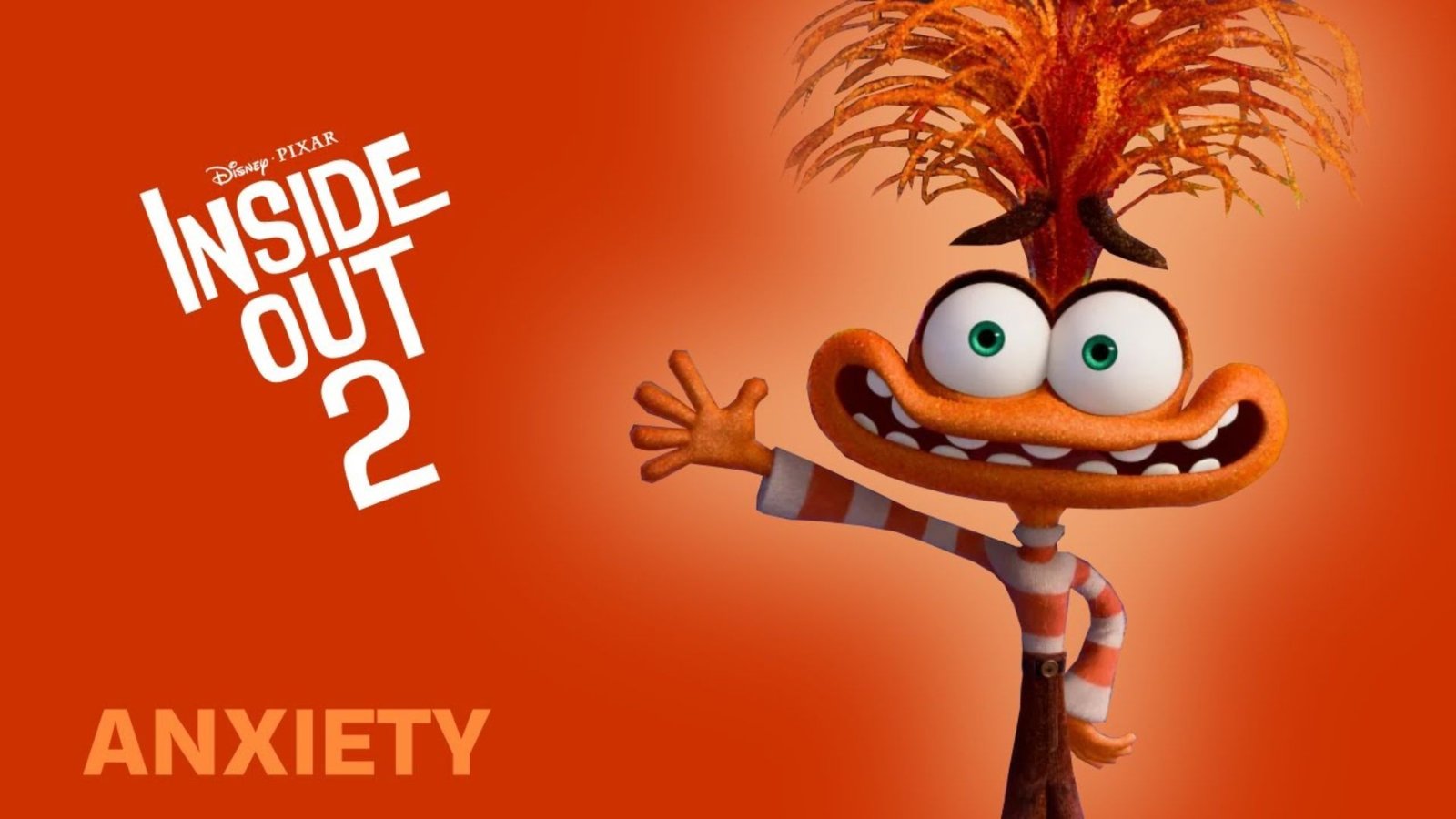
Anxiety inside out 2 is one of the film’s most memorable additions because the character represents more than simply feeling nervous. In Pixar’s sequel, Riley is 13 and entering adolescence, a stage filled with social pressure, uncertainty, identity questions, and new expectations. Anxiety appears alongside other new emotions, including Envy, Embarrassment, and Ennui, as Riley’s emotional world becomes more complicated.
Voiced by Maya Hawke, Anxiety is energetic, highly organized, and constantly focused on what might happen next. She tries to protect Riley by planning for possible problems before they occur. That makes her both helpful and disruptive: her intentions are protective, but her constant search for the perfect outcome eventually overwhelms Riley.
The character gives viewers a simple way to understand a complicated emotional experience: anxiety can sometimes prepare us for challenges, but it can become harmful when fear of possible outcomes takes control.
Who Is Anxiety in Inside Out 2?
Anxiety is one of Riley’s new emotions after puberty begins. Unlike Fear, who primarily reacts to immediate dangers, Anxiety focuses heavily on future possibilities. Pixar describes her as someone who thinks several steps ahead and creates plans to help Riley avoid mistakes and fit in with her peers.
Her motivations are not presented as evil. She genuinely believes that preparing Riley for every possible problem will keep her safe and help her succeed.
That distinction is central to the character. Anxiety does not wake up and decide to make Riley miserable. Instead, she becomes convinced that controlling every possible outcome is the best way to protect Riley.
The problem is that the future cannot be completely controlled.
Anxiety vs. Fear
One of the film’s clearest ideas is the difference between Fear and Anxiety.
| Emotion | Main Focus | How It Protects Riley |
|---|---|---|
| Fear | Immediate or visible danger | Encourages caution |
| Anxiety | Possible future problems | Encourages preparation |
| Disgust | Unpleasant or undesirable situations | Helps Riley avoid things she dislikes |
| Envy | What others have or achieve | Highlights comparison and desire |
| Embarrassment | Social exposure and awkwardness | Encourages social awareness |
This distinction also connects with psychological explanations of anxiety. Researchers and psychologists have noted that anxiety can involve anticipating possible negative outcomes, while fear is more closely connected with an immediate perceived threat. The film simplifies these concepts for storytelling, but the comparison helps make the emotional difference easier to understand.
Why Does Anxiety Take Control of Riley?
Riley is entering a new stage of life where friendships, belonging, performance, and identity become increasingly important. At hockey camp, she wants to impress older players and become accepted by them. Anxiety interprets these pressures as problems that must be solved immediately.
She starts creating elaborate plans around Riley’s future. Her thinking becomes increasingly focused on avoiding embarrassment, rejection, and failure.
This is where anxiety inside out 2 becomes especially relevant to teenagers. Adolescence involves rapid physical, social, emotional, and cognitive changes. Young people can become more aware of how others perceive them while also developing more sophisticated ways of imagining possible futures.
Anxiety therefore has plenty of material to work with.
The character’s mistake is not caring about Riley. It is believing that Riley must become perfect to be safe, accepted, and successful.
What Does Anxiety Represent?
Anxiety represents the part of the mind that constantly asks, “What if something goes wrong?”
That question can be useful. It may encourage someone to prepare for an exam, practice before a performance, think through a difficult conversation, or consider consequences before making a decision.
But the same process can become exhausting when every possibility feels like a threat.
In the movie, Anxiety tries to build a better version of Riley by controlling her choices and shaping her sense of self. The story shows what can happen when preparation turns into excessive control.
Psychological commentary on the film has similarly highlighted Anxiety as a protective emotion that becomes problematic when it operates without balance. The film’s consultants and outside psychologists have discussed the importance of portraying anxiety as something that can serve a purpose rather than simply treating it as an enemy.
💡 Pro Tip:
If you are using the movie to talk with a teenager about anxiety, ask what Anxiety is trying to protect Riley from rather than asking whether Anxiety is “bad.” This can make the conversation less judgmental and more focused on understanding emotions.
The Panic Attack Scene
One of the most significant moments involving Anxiety occurs during Riley’s hockey game. After becoming overwhelmed by pressure and self-criticism, Riley experiences a panic attack.
The scene depicts rapidly increasing breathing, physical tension, racing thoughts, and difficulty regaining control. Riley eventually begins reconnecting with her surroundings and settles down.
The sequence is important because it moves beyond the film’s humorous personification of emotions. Anxiety is no longer simply a character making frantic plans. Riley is experiencing the physical and emotional consequences of becoming overwhelmed.
The scene also communicates an important distinction: experiencing anxiety does not automatically mean someone has an anxiety disorder. Anxiety is a normal human emotion, while anxiety disorders involve clinically significant patterns that can interfere with daily life. The film presents an accessible fictional depiction rather than a clinical diagnosis.
What Can Viewers Learn From Anxiety?
The central lesson of anxiety inside out 2 is not that people should eliminate anxiety. Instead, the story suggests that emotions work better when they are integrated rather than allowed to dominate everything.
Anxiety wants certainty. Riley cannot have certainty.
That conflict is particularly relevant during adolescence, when friendships, school, appearance, performance, and future plans can all feel unusually important. Professional commentary on the film has noted that adolescence can bring greater self-consciousness and concern about belonging, making the movie’s emotional conflict recognizable to many young viewers.
The film also shows why emotional awareness matters. Naming an emotion can make it easier to understand what that emotion is attempting to accomplish. Anxiety may be warning about rejection, failure, embarrassment, or uncertainty. Recognizing the warning is different from obeying every warning.
Is Anxiety a Villain?
No. The movie deliberately avoids presenting Anxiety as a traditional villain.
She causes serious problems for Riley, but her underlying goal is protection. Pixar’s description emphasizes her desire to prepare Riley for negative possibilities and help her succeed socially. Psychological commentary surrounding the film likewise describes Anxiety as a well-intentioned protective force that can become overwhelming when taken too far.
That makes the character more relatable than a simple antagonist would be.
The story does not suggest that Riley should never feel anxious. Instead, it shows why anxiety needs limits and why one emotion should not be responsible for every decision.
Why the Character Resonates With Teenagers and Adults
Although Riley is a teenager, the emotional conflict is not limited to adolescence. Adults can recognize the same pattern in worries about work, relationships, finances, social situations, health, or future decisions.
The difference is that Riley’s concerns are presented visually through the characters inside her mind.
That creative approach makes an invisible process easier to discuss. A viewer can see Anxiety making plans, imagining negative outcomes, and attempting to control Riley’s identity. Instead of treating anxiety as an abstract concept, the film turns it into a character with understandable motives.
This is one reason the movie has been discussed by psychologists, educators, and mental-health professionals as a useful starting point for conversations about emotions.
📌 Key Takeaway:
Anxiety in the movie is not something Riley needs to destroy. It represents a protective emotional system that becomes unhelpful when it demands certainty, perfection, and complete control. The healthier message is to recognize anxiety, understand its warning, and allow other emotions to remain part of the decision-making process.
Frequently Asked Questions
Who voices Anxiety in Inside Out 2?
Maya Hawke voices Anxiety in Inside Out 2. Pixar introduced the character as one of Riley’s new emotions during adolescence. Hawke’s performance gives Anxiety a fast-moving, enthusiastic personality that matches the character’s constant planning and concern about possible future problems.
Why is Anxiety introduced in Inside Out 2?
Anxiety is introduced because Riley is entering adolescence, bringing new social and emotional challenges. The character represents Riley’s growing ability to imagine possible futures and worry about what could happen. The movie uses Anxiety to explore concerns about belonging, performance, identity, and making mistakes.
Is Anxiety different from Fear in Inside Out 2?
Yes. Fear is primarily associated with protecting Riley from dangers she can recognize, while Anxiety focuses more heavily on possible future problems. The distinction is simplified for the movie, but it provides a useful way to understand why anticipation and immediate danger can produce different emotional responses.
Does Inside Out 2 show a panic attack?
Yes. Riley experiences a panic attack during a stressful hockey-game sequence. The film depicts escalating physical and emotional distress before Riley gradually reconnects with her surroundings and regains control of her breathing. The scene is one of the movie’s clearest depictions of anxiety becoming overwhelming.
What is the main message about anxiety in the movie?
The movie presents anxiety as neither completely good nor completely bad. It can help a person prepare for challenges, but excessive worry and the pursuit of perfection can become overwhelming. Riley’s story suggests that anxiety works better as one part of emotional life rather than as the force controlling every decision.
Conclusion
Anxiety inside out 2 gives a complicated emotion a recognizable personality. Anxiety wants Riley to be prepared, accepted, and successful, but her constant attempts to control the future eventually create the very distress she is trying to prevent.
The character’s value comes from that contradiction. Anxiety can offer useful warnings without needing to run the entire system. By showing Riley learning to live with uncertainty rather than eliminate it, Inside Out 2 turns a colorful animated character into a useful starting point for conversations about adolescence, emotional balance, and self-acceptance.
