


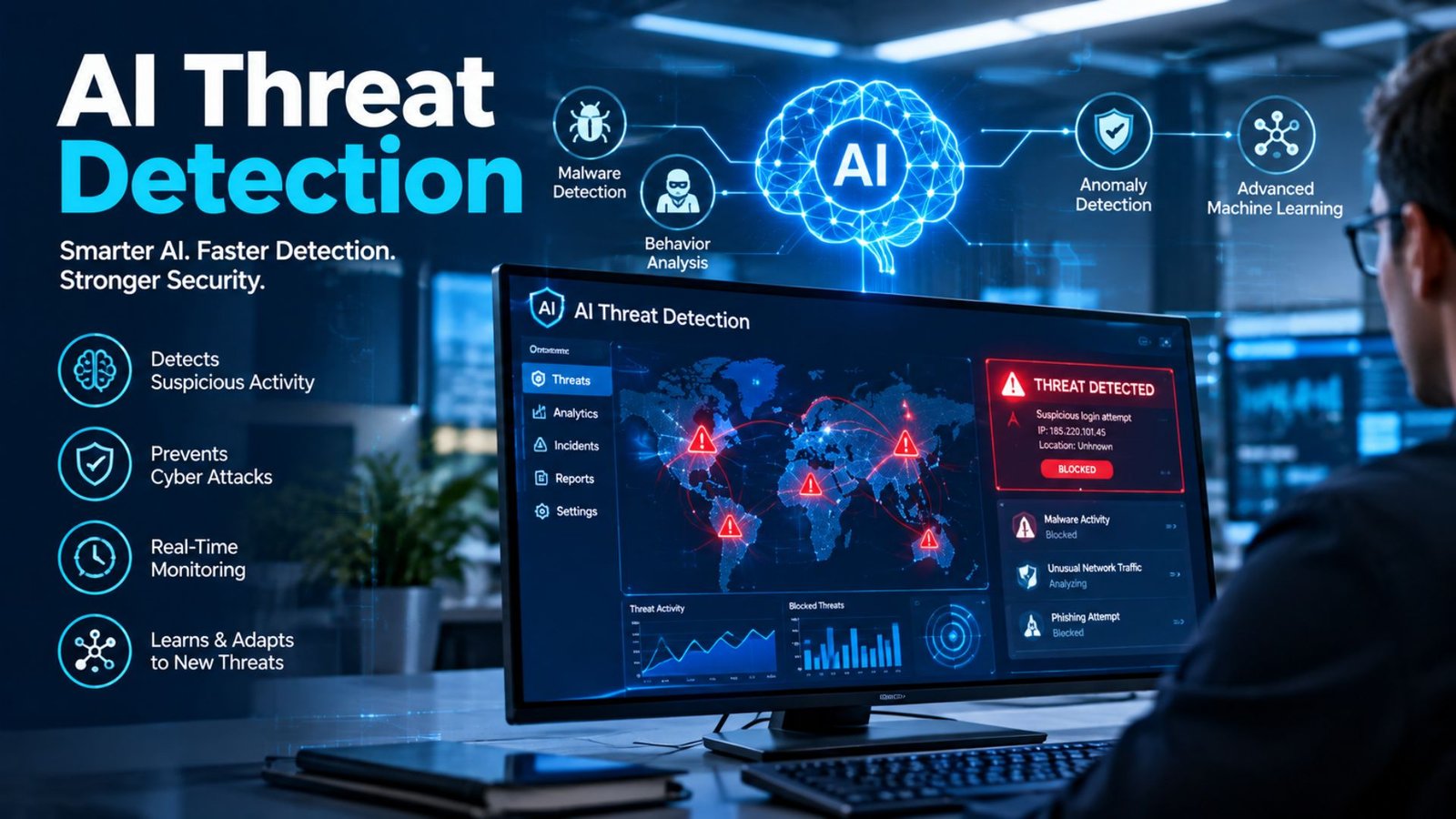
AI threat detection uses artificial intelligence and machine learning to identify suspicious activity across networks, endpoints, cloud systems, applications, and user accounts. Instead of relying only on known attack signatures, modern security platforms can examine behavior, detect unusual patterns, prioritize alerts, and help analysts investigate incidents faster. Microsoft describes AI for cybersecurity as a way to automate detection, analyze large volumes of data, identify patterns, and support real-time response.
The practical aim is better visibility across large data sets while keeping human analysts involved in decisions that require context and judgment. It can complement EDR, SIEM, intrusion detection, threat intelligence, and UEBA.
What Is AI Threat Detection?
At its core, AI threat detection analyzes security telemetry for evidence that activity differs from expected behavior or resembles malicious activity. Techniques include supervised learning, anomaly detection, deep learning, natural-language processing, and generative AI.
Traditional signature-based tools remain useful for recognized threats, but they can struggle when an attack changes its code, uses previously unseen infrastructure, or behaves differently from known samples. AI can add another layer by examining behavior and relationships between events rather than waiting for an exact signature match.
For example, a compromised account might suddenly access an unusual application, download unusual amounts of data, and authenticate from an unexpected location. Correlating those signals can give analysts a stronger reason to investigate.
How AI Threat Detection Works
A typical workflow has several stages:
- Collect data: Gather logs, network traffic, endpoint events, authentication records, cloud activity, email signals, and threat intelligence.
- Establish context: Compare activity with learned patterns or known malicious indicators.
- Detect anomalies: Identify behavior that deserves attention.
- Prioritize alerts: Correlate events and help separate serious incidents from routine noise.
- Support investigation: Summarize events and surface relevant evidence.
- Trigger a response: Depending on configured controls, actions may include blocking traffic, isolating an endpoint, or requiring additional authentication.
AI Threat Detection Techniques
Different approaches solve different problems. Anomaly detection establishes a baseline and flags deviations. Supervised models classify events using labeled examples, while unsupervised approaches can identify unusual patterns when labeled attack data is limited. Generative AI can assist with summaries and investigation workflows, but its outputs still require validation.
| Detection approach | What it looks for | Typical security use |
|---|---|---|
| Signature-based | Known malicious patterns | Known malware and indicators |
| Anomaly detection | Deviations from normal behavior | Account and network monitoring |
| Behavioral analytics | Suspicious sequences of actions | Account compromise investigations |
| ML classification | Learned malicious or benign patterns | Malware and phishing detection |
| Threat intelligence | Known indicators and context | IPs, domains, and hashes |
Where AI-Based Detection Helps Most
One major strength is scale. Enterprise environments generate large amounts of telemetry, making manual review difficult. AI can filter, correlate, and prioritize this information.
Network monitoring can identify unusual connections, scanning activity, or suspicious data transfers. Cloud environments can benefit from anomaly detection, while endpoint security can assess files, processes, and other signals for suspicious execution.
User and entity behavior analytics can also flag unusual logins, access patterns, or data movement. AI threat detection is increasingly relevant to zero-day and evasive threats because behavioral and machine-learning techniques can identify activity without relying solely on traditional signatures.
💡 Pro Tip:
Treat AI-generated alerts as investigation leads, not automatic proof of compromise. Define what evidence analysts must verify before containment, especially before disabling accounts or isolating production systems.
Benefits and Limitations
Benefits include faster analysis, broader visibility, automated correlation, and improved alert prioritization. AI can handle repetitive tasks so security teams can focus on incidents requiring deeper analysis.
There are limits. Models can generate false positives, miss sophisticated attacks, or perform poorly when training data does not represent the environment being protected. Attackers can also adapt their techniques to evade detection models.
Incomplete logs and noisy telemetry can reduce detection quality. Organizations should also consider privacy, access controls, model security, and the risks of high-impact automated actions.
NIST has highlighted the challenge of monitoring deployed AI systems, noting that AI can introduce variability and unpredictable behavior that makes post-deployment monitoring important.
Building a Practical AI Security Strategy
Organizations should start with visibility rather than buying an isolated “AI” product. Map important assets, available telemetry, and the detection gaps creating the greatest operational risk.
A practical approach includes:
- Centralize useful telemetry: Connect critical endpoint, identity, network, cloud, and application data.
- Set clear baselines: Understand normal activity for important users, systems, and services.
- Prioritize high-value detections: Focus on account compromise, malware, data exfiltration, privilege abuse, and suspicious network behavior.
- Keep analysts in the loop: Require human validation for sensitive or disruptive actions.
- Test continuously: Measure false positives, missed detections, investigation time, and response quality.
- Review detections: Update rules and models as infrastructure and attack techniques change.
The threat landscape creates a two-sided AI problem: defenders use AI to detect attacks while adversaries can use it to accelerate vulnerability discovery and attack development. Recent industry announcements emphasize this changing pace; such claims are vendor or industry assessments rather than universal measurements.
📌 Key Takeaway
Effective AI threat detection is less about replacing traditional security tools and more about combining machine-assisted analysis with strong telemetry, established controls, and human oversight. A useful system produces actionable signals, explains why an event matters, and supports a response process analysts can verify.
Frequently Asked Questions
Is AI threat detection better than traditional antivirus?
AI-based detection and traditional antivirus serve different purposes. Signature-based antivirus remains useful for known threats, while machine-learning and behavioral techniques can identify patterns that do not exactly match known signatures. Modern endpoint products often combine several methods rather than replacing one with another.
Can AI detect zero-day attacks?
AI can help identify previously unseen attacks by recognizing anomalous behavior, suspicious code characteristics, or unusual network activity. It cannot guarantee detection of every zero-day. Effectiveness depends on the model, available telemetry, configuration, and the attacker’s techniques.
What data does an AI detection system need?
Common inputs include endpoint telemetry, authentication events, network traffic, DNS activity, cloud logs, application events, email signals, and threat intelligence. The right mix depends on the organization’s environment and the threats it needs to detect.
Does AI threat detection replace cybersecurity analysts?
No. AI can automate analysis, correlation, summarization, and selected response actions, but analysts remain important for validation, investigation, risk assessment, and decisions involving business context. Human oversight is especially valuable when automated actions could disrupt critical systems.
How can organizations reduce false positives?
Start with reliable telemetry and clear behavioral baselines. Tune detection thresholds using real environment data, correlate multiple signals, prioritize alerts by risk, and review noisy rules regularly. Analyst feedback can help improve detection quality over time.
Conclusion
AI threat detection is an important layer in modern cybersecurity because teams must process more signals while facing attacks that can change quickly. Its strongest role is to identify patterns, connect events, reduce investigation workload, and surface suspicious behavior that traditional methods may miss.
It works best as part of a broader security program. Good telemetry, carefully designed detections, human validation, testing, and clear response procedures remain essential. Organizations should treat detection as an ongoing process rather than a one-time product purchase.
