


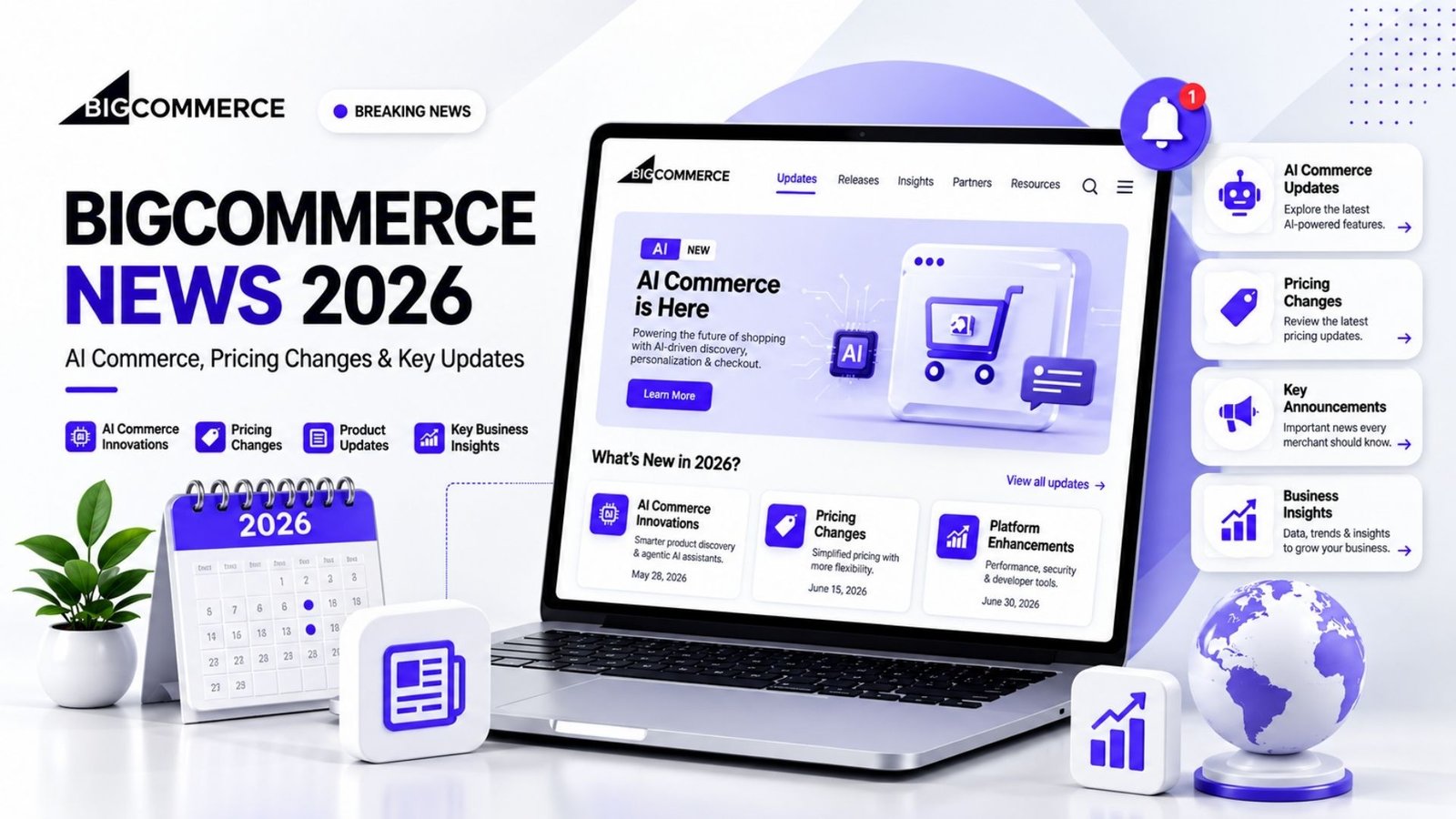
BigCommerce news in 2026 is centered on a clear shift: the platform is moving deeper into AI-driven commerce, payments, B2B selling, headless storefronts, and a broader Commerce ecosystem. For merchants, the biggest developments are not simply new features. Pricing and plan changes, AI-powered discovery, payment options, platform improvements, and enterprise adoption could all affect how an online store is operated.
The latest announcements also show that BigCommerce remains focused on businesses that need flexibility beyond a basic online storefront. Recent company updates include new commerce capabilities, expanded payment functionality, headless deployments, and continued investment in B2B and artificial intelligence.
BigCommerce News: The Biggest 2026 Developments
Several announcements stand out when looking at the latest BigCommerce news. They reveal where the platform is heading and which changes deserve the closest attention from merchants.
| Development | What changed | Why merchants should care |
|---|---|---|
| Pricing and plans | New plan names, GMV thresholds and an open-payment-provider fee | May affect operating costs and plan selection |
| AI commerce | Greater focus on intelligent discovery and agentic shopping | Products may increasingly be discovered through AI |
| Payments | BigCommerce Payments by PayPal launched for U.S. merchants | Adds a more integrated payment option |
| B2B commerce | Strong performance in the 2026 Paradigm B2B Combine | Relevant to growing wholesale and enterprise stores |
| Headless commerce | New deployments and continued Catalyst development | Gives larger brands more storefront flexibility |
Pricing and Plan Changes
One of the most commercially significant updates is BigCommerce’s 2026 pricing and plan restructuring. The company says the changes took effect June 1, 2026, with new plan names and revised GMV thresholds. It also introduced a fee for orders processed through Open Payment Providers on self-service plans.
This matters because merchants should evaluate their actual payment mix and sales volume rather than looking only at the headline subscription price.
A store that relies heavily on an external payment provider may have a different cost profile from one using an integrated option. Before changing plans, businesses should compare their annual GMV, payment processing arrangements, expected growth and total platform costs.
AI Is Becoming a Core Commerce Story
Another major theme in BigCommerce news is the movement toward AI-assisted shopping.
At Commerce Live 2026, the company introduced product innovations across storefronts, B2B, payments and AI-driven commerce. The announcements included capabilities designed for an environment in which customers increasingly discover products through intelligent systems rather than traditional search alone.
The direction became even clearer through research released with PayPal in June. Commerce reported that two-thirds of consumers surveyed were ready to try agentic shopping, although many wanted human approval before an AI system completed a purchase.
For merchants, this suggests that product information needs to become increasingly structured, accurate and machine-readable. Clear product names, descriptions, attributes, availability and pricing are valuable not only for shoppers but also for emerging AI-powered discovery experiences.
💡 Pro Tip: Review your top-selling product pages for missing attributes, inconsistent product data and vague descriptions. Improving the underlying catalog information can make your products easier for both traditional search engines and newer AI shopping systems to understand.
BigCommerce Payments and PayPal
Payments are another important part of the latest platform developments.
In May 2026, Commerce announced BigCommerce Payments by PayPal for U.S. merchants. The embedded solution is designed to provide a unified financial view while supporting payment options such as PayPal Pay Later.
The timing is significant because payment infrastructure is becoming increasingly connected to checkout optimization and merchant operations. For U.S. businesses, an integrated option may simplify parts of payment management, although merchants should still compare transaction costs, payment-method coverage and operational requirements before making a change.
The development also connects with BigCommerce’s broader strategy of making commerce infrastructure more integrated while retaining an open architecture.
B2B Continues to Be a Strength
B2B commerce remains an important area for the platform.
In July, Commerce announced that BigCommerce achieved 24 out of 24 total medals across the 2026 Paradigm B2B Combine’s Enterprise and Midmarket editions for the fourth consecutive year. The company also reported six gold and six silver medals in the Enterprise edition and more gold medals than other platforms in the Midmarket edition.
These awards are third-party evaluation results rather than a guarantee that the platform will suit every B2B company. Still, they indicate that B2B functionality remains a major part of the product’s positioning.
Businesses selling wholesale products should pay particular attention to capabilities involving account management, pricing structures, purchasing workflows, catalogs and integrations. The right choice depends on operational complexity, not simply the number of features listed on a product page.
Headless Commerce Is Still Moving Forward
Headless architecture continues to appear prominently in BigCommerce news.
In July, Laser Clinics announced a global headless commerce platform built on BigCommerce, supporting its network of nearly 200 clinic locations. Commerce described the project as a replacement for a more rigid legacy architecture.
The company is also continuing to improve Catalyst, its modern storefront technology. Catalyst 1.9.0 added product-video support, promotion callouts and improvements to cart reliability, among other updates.
For brands with sophisticated front-end requirements, this matters because headless commerce separates the customer-facing experience from much of the underlying commerce infrastructure. It can offer greater design and development flexibility, although it can also require more technical resources than a conventional storefront.
What the Latest Financial Results Tell Merchants
The financial side provides useful context for interpreting the platform’s direction.
Commerce reported second-quarter 2026 revenue of $84.5 million, 14% GMV growth and total annual recurring revenue of $360.5 million. The company also reported GAAP net income of $1.1 million and positive operating cash flow of $5.1 million for the quarter.
The results suggest that management is emphasizing execution, monetization and investment in product intelligence and AI-driven commerce. That does not automatically translate into better results for every merchant, but it helps explain why AI, payments and platform expansion feature so prominently in recent announcements.
What Merchants Should Watch Next
The most useful way to follow BigCommerce news is to separate announcements from changes that require action.
Merchants should monitor four areas closely:
- Pricing: Recalculate platform costs after the 2026 plan changes, especially if using Open Payment Providers.
- AI discovery: Improve product data so catalogs are prepared for emerging AI shopping experiences.
- Payments: Compare integrated payment options with existing providers based on total cost and functionality.
- Storefront technology: Consider headless architecture only when the business has a clear reason to need greater front-end control.
Businesses should also distinguish between a new feature announcement and a generally available feature. Product roadmaps, beta programs and regional availability can differ from what is immediately accessible to every merchant.
📌 Key Takeaway: The biggest story is not one isolated feature. The latest BigCommerce news points toward a platform increasingly designed around AI-assisted discovery, integrated payments, flexible storefront architecture and sophisticated B2B commerce. Merchants should focus on the changes that affect their own costs, workflows and customer journey rather than chasing every announcement.
Conclusion
The direction of BigCommerce news in 2026 is broader than a normal stream of ecommerce feature announcements. Pricing has changed, AI is becoming more central to product discovery, payments are becoming more integrated, and B2B and headless commerce remain important parts of the platform’s strategy.
For merchants, the practical response is to focus on impact. Review your costs, strengthen product data, assess payment options and make technology decisions according to your business model. That approach is more useful than reacting to every headline—and it provides a clearer way to judge which BigCommerce developments actually matter to your store.
Frequently Asked Questions
What is the latest BigCommerce news in 2026?
Recent developments include pricing and plan changes, BigCommerce Payments by PayPal for U.S. merchants, AI-driven commerce initiatives, B2B recognition and continued headless storefront development. Commerce’s August financial results also reported $84.5 million in second-quarter revenue and 14% GMV growth.
Did BigCommerce change its pricing in 2026?
Yes. BigCommerce announced a plan and pricing restructuring effective June 1, 2026. The changes include new plan names, updated GMV thresholds and a fee for orders processed through Open Payment Providers on self-service plans. Merchants should review their individual account economics before selecting or changing plans.
Is BigCommerce focusing on AI?
Yes. AI-driven commerce is now a major part of the company’s product strategy. Commerce has introduced AI-related commerce capabilities and research around agentic shopping, while its broader strategy emphasizes intelligent discovery and personalized commerce experiences.
Is BigCommerce suitable for B2B ecommerce?
It can be a strong option for B2B organizations, particularly those needing sophisticated commerce capabilities. BigCommerce received 24 out of 24 total medals in the 2026 Paradigm B2B Combine across Enterprise and Midmarket editions. However, businesses should evaluate features against their specific catalogs, purchasing workflows and integrations.
What should BigCommerce merchants watch next?
Merchants should monitor pricing, AI-powered discovery, payment developments, storefront technology and B2B capabilities. It is also useful to follow official release notes because feature availability and technical improvements can change independently of major corporate announcements.
