


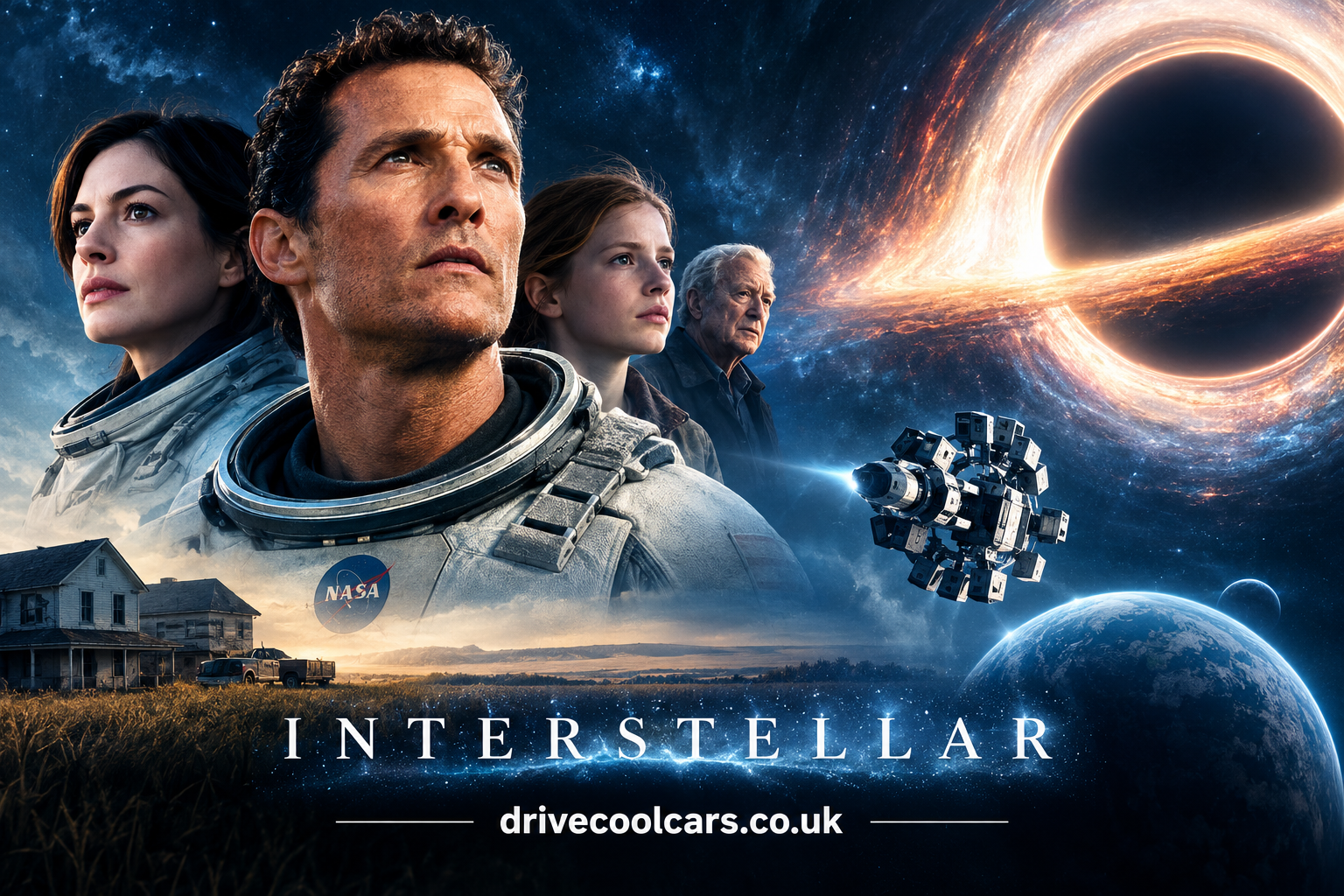
Christopher Nolan’s Interstellar (2014) combines space adventure with family drama, relativity and questions about humanity’s future. The film follows Cooper, a former NASA pilot played by Matthew McConaughey, who joins a wormhole mission as Earth faces a severe agricultural crisis. Its scientific ideas remain tied to Cooper’s relationship with his daughter, Murph.
What Is Interstellar About?
Interstellar begins on a future Earth where crop failures and dust storms threaten civilization. Cooper lives as a farmer with his children, but his engineering and piloting background becomes valuable when he discovers a secret NASA operation.
NASA’s remaining scientists are investigating a wormhole near Saturn that offers a possible route to distant planetary systems. Cooper joins a team led by Dr. Amelia Brand, played by Anne Hathaway, to investigate worlds that might support human life.
The mission creates the film’s central conflict: every year Cooper spends away from Earth can represent years for the people he left behind. The mission becomes a story about time, sacrifice and exploration.
Interstellar Cast and Characters
The cast gives the film its human scale. McConaughey plays Cooper, a practical pilot and engineer afraid of losing his children. Hathaway plays Amelia Brand, a scientist tested by the mission’s extreme conditions.
Jessica Chastain plays the adult Murph, who remains determined to understand the strange gravitational events connected to her father’s departure. Michael Caine plays Professor John Brand, the senior scientist directing NASA’s plan. The ensemble also includes Casey Affleck, Matt Damon, John Lithgow and Timothée Chalamet.
| Element | Key detail | Why it matters |
|---|---|---|
| Director | Christopher Nolan | Shapes the film’s visual and narrative scale |
| Lead | Matthew McConaughey as Cooper | Provides the emotional viewpoint |
| Scientific adviser | Kip Thorne | Helped ground major concepts in physics |
| Runtime | 169 minutes | Allows room for its large story and ideas |
| Genre | Science fiction, adventure, drama | Combines spectacle with family themes |
The Science Behind the Film Interstellar
One reason the film remains distinctive is its effort to visualize difficult physics rather than treating science as decoration. Kip Thorne, the theoretical physicist who served as scientific adviser and executive producer, worked with the filmmakers on the story’s scientific foundations.
The most famous example is Gargantua, the film’s rapidly spinning supermassive black hole. The visual-effects team developed the Double Negative Gravitational Renderer, or DNGR, to calculate how light would travel through curved spacetime around a spinning black hole. The work was detailed enough that the renderer was later adapted for scientific research.
The movie also uses gravitational time dilation as a major story device. Near a sufficiently strong gravitational field, clocks can run at different rates relative to distant observers. That concept helps explain why time passes so differently for Cooper and his children.
The film is not a physics textbook. Some elements are deliberately speculative, particularly the wormhole and its interpretation of higher dimensions. The movie uses real scientific principles as a foundation, then builds a fictional narrative on top of them.
💡 Pro Tip: Watch the film twice if the physics feels confusing. On a second viewing, pay attention to the relationship between gravity, time and distance rather than trying to solve every scientific idea at once.
Why the Black Hole Looks Different From Typical Movie Space
Gargantua is more than a visual effect. Its appearance reflects gravitational lensing: light from the accretion disk is bent around the black hole, creating the unusual image seen on screen. Caltech researchers documented how the production team used relativistic ray-tracing techniques to create the effect.
That attention to physical detail helped give the film a visual identity unlike conventional space adventures. Instead of presenting a black hole as a simple dark circle, the movie shows how surrounding light can be distorted by extreme gravity.
Why the Film Interstellar Still Connects With Audiences
The movie’s appeal extends beyond its science. Interstellar turns abstract physics into a personal story.
Cooper’s separation from Murph turns time into an emotional antagonist. A short period for an astronaut can represent years for a child, making ordinary family moments impossible to recover. That gives the film stakes beyond Earth.
The film also reflects a recurring Nolan interest in memory, time and perception. Here, those ideas are tied to a more traditional science-fiction question: can humanity survive by leaving its home planet?
Is the Film Scientifically Accurate?
It is more scientifically grounded than many blockbuster space films, but it is still fiction. The black-hole visualization was developed using calculations based on general relativity, and Thorne’s involvement gave the production an unusually strong scientific foundation. At the same time, the movie takes imaginative liberties to complete its story.
That balance is part of its appeal. Viewers can learn real concepts such as gravitational lensing and time dilation while recognizing that the plot ultimately goes beyond what current science can demonstrate.
📌 Key Takeaway: Interstellar works because its scientific ideas are tied to human consequences. Relativity, black holes and distant planets are not simply spectacle; they make Cooper’s separation from his family more meaningful.
The Ending Explained
Near the end, Cooper enters the black hole and finds himself in a strange higher-dimensional structure where he can perceive moments from Murph’s room across time. He realizes the “ghost” from Murph’s childhood was his own future presence, using gravity to send information. Cooper transmits the crucial data to adult Murph, allowing her to complete Professor Brand’s equation and help humanity leave Earth. Cooper later awakens near Saturn and learns that Murph, now elderly, has survived long enough to see him again. He then leaves to find Amelia Brand.
Frequently Asked Questions
Is Interstellar based on a true story?
No. Interstellar is an original science-fiction story written by Jonathan Nolan and Christopher Nolan. Its scientific concepts draw heavily on established physics, particularly ideas associated with relativity and black holes.
How long is Interstellar?
The film runs for 169 minutes, or 2 hours and 49 minutes. Its long runtime allows the story to move between Earth, deep space and the personal lives of the characters.
Who directed the film?
Christopher Nolan directed the film and co-wrote it with his brother Jonathan Nolan. The movie was released in 2014 and stars Matthew McConaughey, Anne Hathaway and Jessica Chastain.
Is Gargantua a real black hole?
No. Gargantua is a fictional black hole created for the film. Its appearance, however, was designed using physics-based calculations of light moving through curved spacetime around a rotating black hole.
Does the film have a sequel?
There is no released direct sequel to the 2014 film. The story was designed as a standalone feature, so claims about a confirmed sequel should be treated cautiously unless announced by the filmmakers or studio.
Conclusion
Interstellar remains a standout science-fiction film because it connects ambitious ideas with a deeply personal story. Its depiction of black-hole physics, gravitational time dilation and space travel gives the adventure intellectual weight, while Cooper and Murph provide the emotional reason to care about the journey.
For viewers discovering the film today, its biggest reward is not simply understanding every scientific concept. It is seeing how time, distance and gravity can transform a story about a parent trying to return home.
