


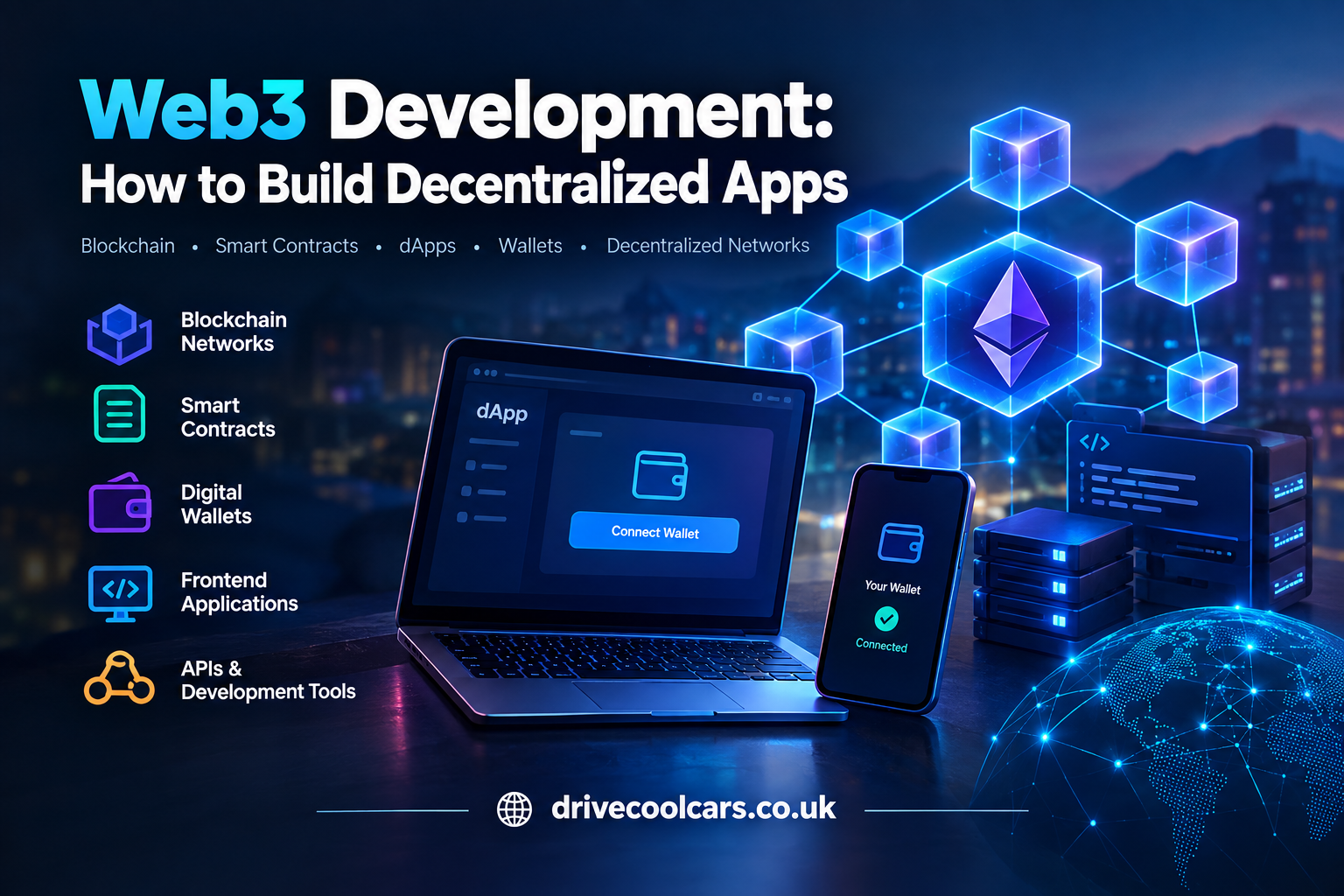
Web3 development focuses on building applications that use blockchain networks, smart contracts, digital wallets, and decentralized infrastructure. Unlike traditional applications that typically rely on centralized servers, Web3 applications can place important logic and data on public blockchain networks. Ethereum describes decentralized applications, or dApps, as applications combining a smart-contract backend with a frontend user interface.
For developers, this creates a different approach to application design. Instead of treating a blockchain as simply a database, Web3 development uses programmable networks to create applications involving digital ownership, payments, financial services, marketplaces, gaming, and other online experiences.
What Is Web3 Development?
Web3 development is the process of designing and building decentralized applications and blockchain-based services. The technology stack can include a blockchain network, smart contracts, frontend software, wallets, APIs, decentralized storage, and development frameworks.
The central difference from Web2 is where application logic runs. In a conventional application, backend code normally runs on infrastructure controlled by a company. A dApp can use smart contracts running on a decentralized network instead. Ethereum’s documentation notes that smart contracts are programs deployed to the blockchain and executed according to their code.
This architecture can give users direct interaction with blockchain-based services without requiring a centralized intermediary to control every transaction.
Key Components of Web3 Development
A practical Web3 project usually involves several connected layers.
Blockchain networks
The blockchain provides the distributed environment where transactions and application state are recorded. Ethereum, for example, provides the Ethereum Virtual Machine (EVM), which executes smart-contract code across the network.
Smart contracts
Smart contracts contain the rules that govern an application’s blockchain interactions. They can manage tokens, ownership, transactions, permissions, and other programmable functions.
Ethereum currently documents Solidity and Vyper as languages used for writing smart contracts that can be compiled for the EVM.
Wallets
Wallets allow users to manage blockchain accounts and authorize transactions. Instead of creating a conventional username-and-password account for every application, a Web3 interface can allow users to connect an existing blockchain wallet.
Frontend applications
The user interface can still be built with familiar web technologies. The difference is that the frontend communicates with blockchain networks and smart contracts rather than relying exclusively on a centralized backend.
APIs and development tools
Developers also use blockchain client APIs, development networks, testing tools, frameworks, and other infrastructure. Ethereum’s developer documentation groups these technologies into a broader development stack.
| Component | Main role | Typical development concern |
|---|---|---|
| Blockchain | Records transactions and state | Network costs and scalability |
| Smart contract | Executes application rules | Security and testing |
| Wallet | Authorizes user actions | User experience and permissions |
| Frontend | Provides the interface | Usability and blockchain integration |
| APIs/tools | Connect applications to networks | Reliability and maintainability |
How Web3 Development Works
A typical dApp starts with a frontend that users can access through a browser. When a user performs an action requiring blockchain state to change, the application can request authorization through a wallet.
The transaction is then submitted to the relevant network. Validators process transactions and update the blockchain according to its consensus rules. On Ethereum, the network uses proof of stake, with validators participating in securing the chain.
Smart contracts handle the programmed logic. For example, a marketplace contract could define how ownership transfers occur, while a financial application could use contracts to execute predefined transactions.
This model makes careful testing particularly important. Smart-contract interactions can be difficult to reverse, and deployed contract code may be immutable by default. Ethereum specifically warns developers to design and test contracts carefully.
💡 Pro Tip: Build and test smart-contract functionality on a development or test environment before deploying production contracts. Treat contract security as a core product requirement rather than a final checklist item.
What Can You Build With Web3 Development?
The technology supports a wide range of application types. Ethereum identifies examples including marketplaces, financial applications, games, digital assets, and other user-facing services.
Common categories include:
- Decentralized finance applications
- NFT and digital-ownership platforms
- Blockchain games
- Token-based communities
- Decentralized marketplaces
- On-chain identity and authentication systems
- Blockchain-based payment applications
The strongest projects generally begin with a clear user problem rather than adding blockchain simply because it is fashionable. A decentralized architecture introduces additional complexity, so the benefits should justify that trade-off.
Web3 Development vs. Traditional Web Development
The biggest difference is not that Web3 replaces normal web programming. In many cases, it adds blockchain functionality to familiar application architecture.
A developer may still need HTML, CSS, JavaScript, frontend frameworks, databases, APIs, authentication concepts, and standard software-engineering practices. The blockchain layer adds new requirements such as transaction handling, wallet connections, gas considerations, contract security, and network selection.
Web3 can also change the ownership model. Ethereum’s explanation of Web3 emphasizes decentralization and user ownership as central ideas behind the broader movement.
For developers coming from Web2, learning blockchain fundamentals before attempting advanced contract development can make the transition much easier.
Challenges Developers Need to Consider
Web3 development offers useful capabilities, but it also introduces constraints.
Security: A vulnerable smart contract can expose users or application assets to serious problems. Testing, code review, and security-focused development are essential.
Scalability: Blockchain networks have different performance and cost characteristics. Developers need to select infrastructure appropriate for the application’s requirements.
User experience: Wallet connections, transaction confirmations, network switching, and blockchain fees can make applications less intuitive than conventional websites.
Immutability: Deployed smart contracts can be difficult to change. Ethereum notes that immutability can provide trust benefits while also making vulnerability fixes more complicated.
Complexity: Developers need to understand both conventional software engineering and blockchain-specific concepts.
📌 Key Takeaway: Successful Web3 development is not simply about putting an application on a blockchain. The strongest implementations use decentralization where it provides a meaningful benefit while keeping the rest of the user experience practical and understandable.
Frequently Asked Questions
Is Web3 development difficult to learn?
It can be challenging because developers need to understand normal programming alongside blockchain concepts such as wallets, transactions, smart contracts, gas, and decentralized networks. Starting with basic blockchain and dApp concepts makes the learning path more manageable.
What programming language is used for Web3 development?
The language depends on the part of the application being built. For Ethereum smart contracts, Solidity and Vyper are established options. Frontend and backend components can use other conventional programming languages and frameworks.
What is a dApp?
A decentralized application combines a user interface with backend logic running on a decentralized network. On Ethereum, smart contracts provide much of that backend functionality.
Do all Web3 applications need a smart contract?
Not necessarily. The architecture depends on the application. However, smart contracts are central to many blockchain applications because they provide programmable rules that users and other applications can interact with.
Is Web3 only about cryptocurrency?
No. Cryptocurrency is an important part of many blockchain systems, but Web3 applications can also involve digital ownership, gaming, identity, marketplaces, authentication, and other decentralized services.
Conclusion
Web3 development combines familiar software engineering with blockchain-specific technologies such as smart contracts, wallets, decentralized networks, and blockchain APIs. Its main appeal is the ability to build applications where important rules and transactions can operate through public, programmable infrastructure rather than depending entirely on a centralized company.
For developers, the best starting point is a solid understanding of blockchain fundamentals followed by practical work with smart contracts, wallets, frontend integration, and testing. As the technology matures, useful Web3 applications will depend less on hype and more on solving real problems with secure, understandable, and well-designed software.
