


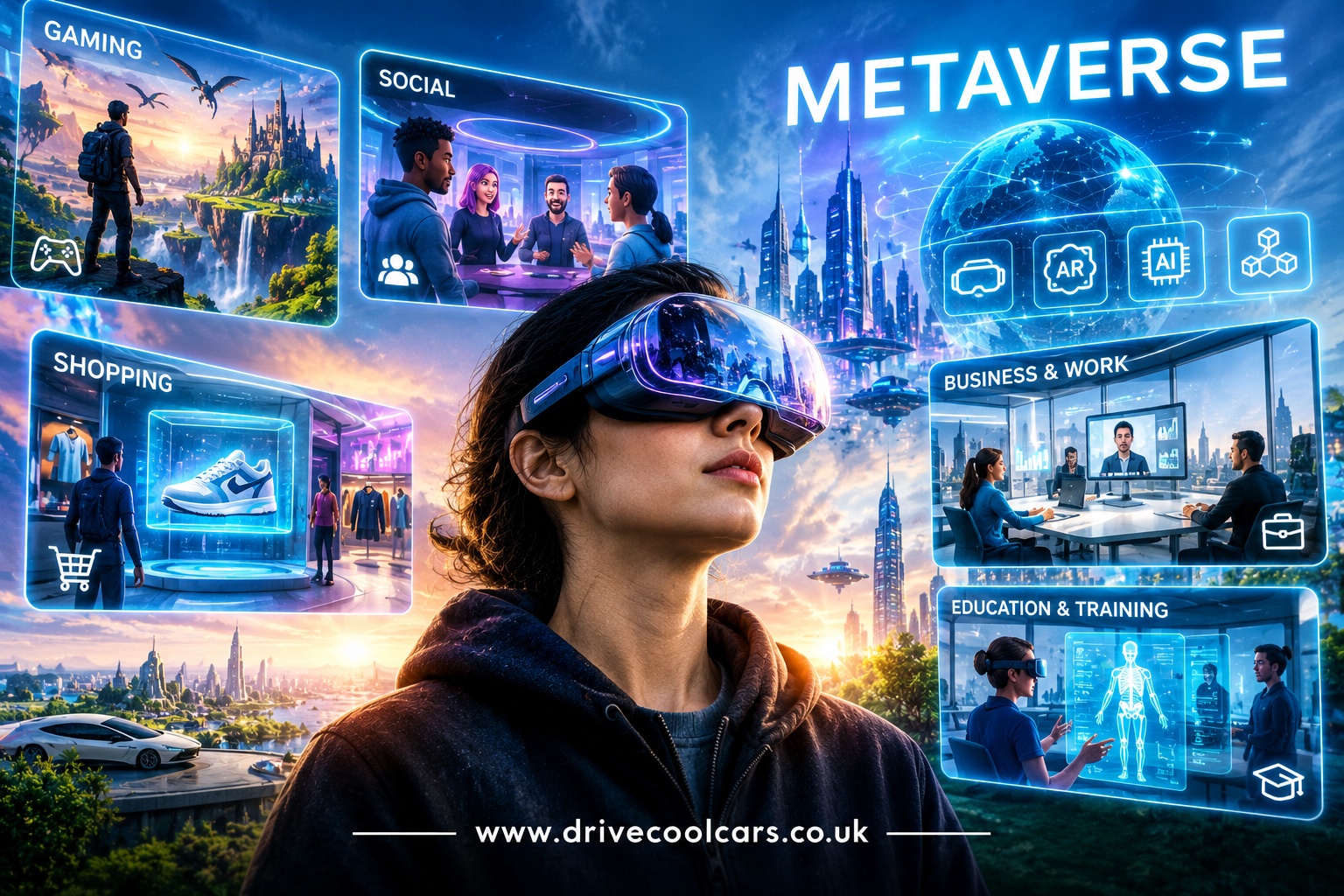
The metaverse describes a broad vision of connected digital spaces where people can interact, work, play, learn and create through immersive or 3D experiences. It is not one website, app or virtual world. Instead, the metaverse brings together technologies such as virtual reality (VR), augmented reality (AR), mixed reality (MR), artificial intelligence, spatial computing and digital identity.
The idea has attracted enormous attention, but the technology is still developing. Some pieces already exist in games, social platforms, virtual workplaces and immersive applications, while the larger vision of persistent, interoperable virtual worlds remains a work in progress.
What Is the Metaverse?
The metaverse is best understood as an evolving network of digital experiences rather than a single destination. Meta describes it as an evolution of social connection that can include familiar 2D experiences, augmented environments and fully immersive 3D spaces.
A user might access an immersive experience through a VR headset, computer, smartphone or another compatible device. Depending on the platform, people can appear through avatars, communicate with others, explore digital environments and interact with virtual objects.
The important distinction is that not every virtual world is automatically the metaverse. The broader concept emphasizes connected experiences, persistent digital environments and the ability to participate socially or economically.
How Does the Metaverse Work?
Several technologies contribute to the experience.
| Technology | Role in virtual worlds | Example use |
|---|---|---|
| Virtual reality | Creates immersive digital environments | Games and training |
| Augmented reality | Places digital information over the real world | Navigation and interactive displays |
| Mixed reality | Combines physical and virtual environments | Spatial games and design |
| AI | Generates content and supports interactions | Digital assistants and characters |
| Spatial computing | Understands physical space and 3D relationships | Room-aware applications |
| Blockchain | Can support digital ownership and transactions | Digital assets and identity |
VR can place the user inside a computer-generated environment, while AR adds digital information to the physical world. Mixed reality goes further by allowing virtual objects and physical surroundings to interact.
Modern headsets are becoming increasingly aware of their surroundings. Meta’s Horizon OS documentation, for example, describes scene understanding that can identify walls, floors, furniture and other physical surfaces.
That spatial awareness is important because immersive computing becomes more useful when digital content responds naturally to the user’s actual environment.
Where Is It Being Used?
The most visible applications are gaming and entertainment, but the potential uses are much broader.
Gaming and Social Experiences
Virtual worlds can allow people in different locations to meet inside shared digital spaces. Users can attend events, play games, communicate through avatars and explore environments together.
Meta’s current virtual-world experiences include games, sports, music and social activities that can be accessed through headsets as well as other devices.
Education and Training
Immersive environments can make certain lessons easier to visualize. Students could explore a historical setting, examine a virtual scientific model or practise skills inside a simulated environment.
Businesses can also use immersive technology for training where realistic simulation is useful. This can be particularly valuable when physical training environments are expensive, difficult to access or potentially disruptive.
Work and Collaboration
Virtual offices can provide alternatives to traditional video calls by placing participants inside shared 3D spaces. Instead of looking at a grid of faces, colleagues can interact with virtual objects and environments.
The approach is not suitable for every job, but it demonstrates how spatial interfaces could change remote collaboration.
Retail and Product Experiences
Virtual environments can give customers new ways to explore products before purchasing. A person might examine a digital showroom, visualize furniture in a room or experience a virtual product launch.
For automotive brands, immersive technology could eventually make it easier to explore vehicle interiors, compare configurations and experience digital demonstrations without visiting a physical showroom.
The Role of AI
Artificial intelligence is becoming increasingly important to the future of the metaverse. AI can help generate environments, personalize experiences, power conversational characters and make digital spaces more responsive.
The World Economic Forum has highlighted the convergence of AI, spatial computing and blockchain as an important technological development. It argues that these technologies can combine to create new ways of interacting with digital and physical environments.
AI could also reduce the cost of creating virtual content. Instead of manually designing every object or interaction, developers may increasingly use generative systems to create assets and adapt experiences dynamically.
💡 Pro Tip: When evaluating an immersive technology project, start with the user experience rather than the hardware. A simple spatial application that solves a real problem can be more valuable than an impressive virtual environment without a clear purpose.
Why Interoperability Matters
One of the biggest challenges is getting different platforms to work together.
In an ideal open ecosystem, a digital identity, avatar or asset could potentially move between compatible virtual environments. Today, many platforms remain separate, meaning users cannot automatically carry everything from one service into another.
The World Wide Web Consortium’s Metaverse Interoperability Community Group is specifically focused on bridging virtual worlds through areas such as identity, social graphs and inventory.
Interoperability also involves more than technical compatibility. Standards need to address identity, payments, privacy, security, accessibility and ownership. The World Economic Forum has identified these issues as important considerations for building connected virtual environments.
Benefits and Challenges
The potential advantages are significant, but so are the obstacles.
Potential benefits include:
- More immersive communication
- New approaches to education and training
- Virtual collaboration across distances
- Interactive entertainment
- New digital commerce opportunities
- Better visualization of complex information
The challenges include hardware costs, accessibility, privacy, cybersecurity, content moderation and interoperability.
Privacy deserves particular attention because immersive devices can collect information about the user’s environment and interactions. The World Economic Forum has warned that future immersive systems could process sensitive information, making privacy and security important parts of responsible design.
Accessibility is another major issue. If virtual experiences depend on expensive equipment or require particular physical abilities, some people may be excluded. Recent XR accessibility work has therefore focused on areas including avatars, captions, navigation, input methods, comfort and safety.
Is the Metaverse the Future of the Internet?
It may influence the future of the internet, but predictions should be treated carefully.
The technology is moving toward richer spatial experiences rather than simply replacing today’s web with one enormous virtual world. The World Economic Forum describes spatial computing as related to, but distinct from, the metaverse, combining AI, computer vision and extended reality to blend digital information with physical environments.
The European Commission is also treating virtual worlds and Web 4.0 as an area for research, innovation and governance. In December 2025, it launched a European Partnership for Virtual Worlds involving industry, academia, research organizations and end users.
📌 Key Takeaway: The metaverse is not a single product waiting to launch. It is an evolving collection of immersive, social and spatial technologies whose future depends on useful applications, affordable access, interoperability, privacy and responsible development.
Frequently Asked Questions
Is the metaverse a real place?
No. It is a term used for digital environments and connected immersive experiences. These spaces can feel interactive and social, but they exist through software and computing systems rather than as physical locations.
Do you need a VR headset to access the metaverse?
Not necessarily. Some experiences can work through computers, smartphones or other devices. Fully immersive applications may benefit from VR or mixed-reality hardware, but access depends on the individual platform.
What is the difference between VR and the metaverse?
VR is a technology that can place users inside a simulated environment. The metaverse is a broader concept involving interconnected digital experiences, social interaction, identity and persistent virtual spaces.
Is blockchain required for the metaverse?
No. Blockchain can support certain applications involving digital assets, transactions or identity, but it is not a requirement for every virtual world.
What is the future of the metaverse?
The most likely development is continued convergence between AI, spatial computing, AR, VR and other technologies. Rather than one universal virtual world appearing overnight, different immersive applications may gradually become more capable and interconnected.
Conclusion
The metaverse remains an evolving concept rather than a finished product. Its foundations are already visible in virtual reality, mixed reality, social platforms, gaming, AI and spatial computing.
Its long-term success will depend less on futuristic branding and more on whether these technologies solve practical problems. Better interoperability, stronger privacy protections, accessible design and useful applications could determine how deeply immersive digital experiences become part of everyday life.
