


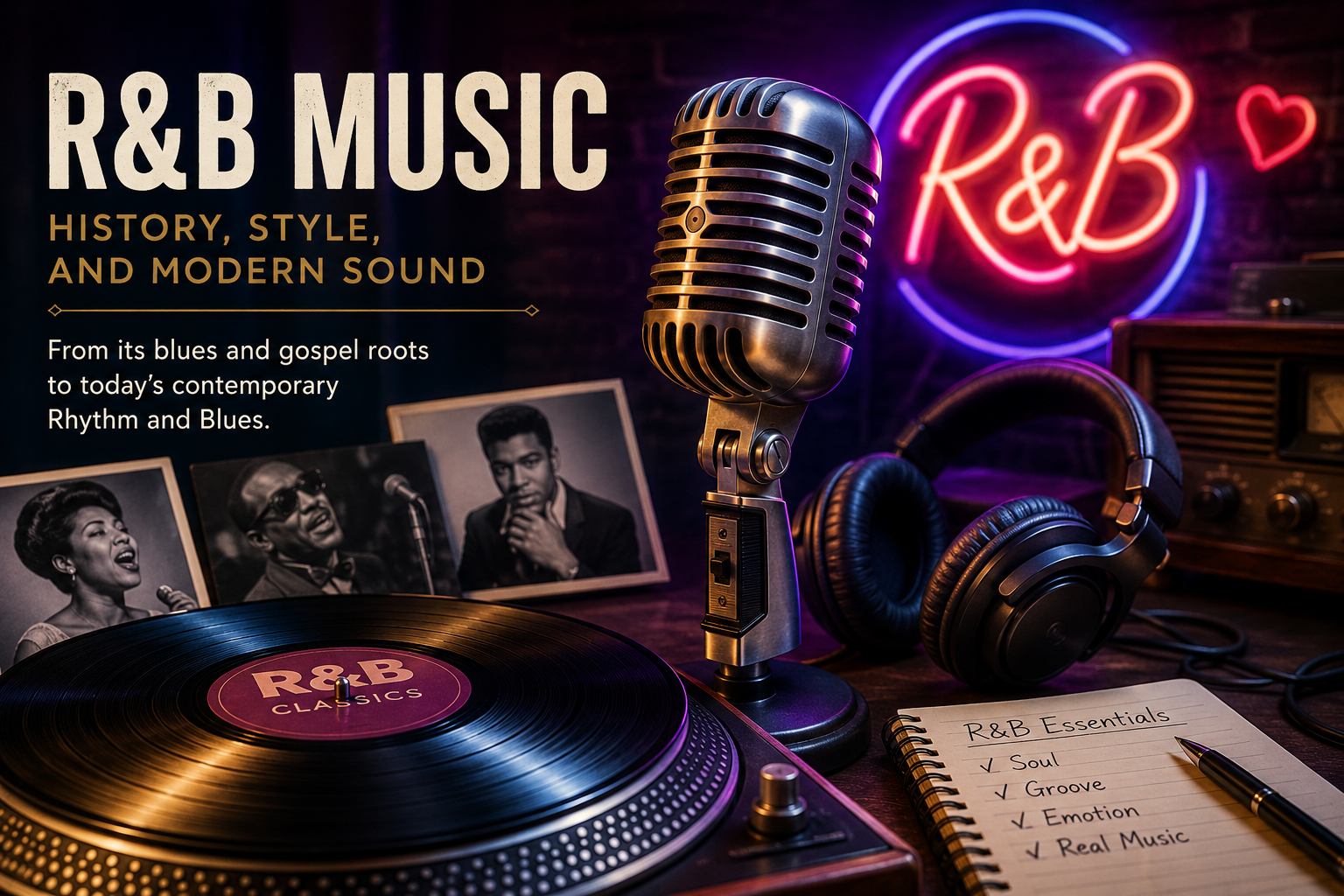
R&B music has changed dramatically since the term first appeared in the 1940s, yet its emotional core remains recognizable. Built from the traditions of blues, gospel, jazz, and African American popular music, the genre has influenced rock, soul, funk, hip-hop, and modern pop. The Library of Congress notes that the term “rhythm and blues,” commonly shortened to R&B, originated in the 1940s.
Today, the label can describe everything from classic soul records to polished contemporary tracks driven by programmed drums, atmospheric production, and expressive vocals. Understanding that evolution makes it easier to recognize what connects different generations of R&B.
What Is R&B Music?
R&B music is a broad style of popular music associated with strong rhythms, expressive vocals, blues-based influences, and roots in African American musical traditions. Its sound has never remained fixed. Early rhythm and blues developed alongside jump blues, jazz, gospel, and blues, while later forms absorbed elements of soul, funk, disco, hip-hop, and electronic production.
The original meaning of the term was also different from how people commonly use “R&B” today. In the mid-20th century, it was largely an industry term for popular recordings associated with Black audiences. Over time, its meaning expanded as musicians and producers introduced new sounds.
That flexibility is one reason the genre has remained relevant rather than becoming tied to a single decade.
How R&B Music Developed
The roots of R&B Music reach reach into several musical traditions. Blues contributed its emotional storytelling and harmonic language, while gospel brought powerful vocals, call-and-response techniques, and expressive phrasing. Jazz and swing added rhythmic sophistication and instrumental ideas.
By the 1940s, these influences were meeting in increasingly urban musical environments. Bands often featured drums, bass, piano, guitar, and horns, creating a more energetic sound suited to dancing and radio. The Library of Congress identifies the 1940s as the period when the R&B Music label emerged.
The 1950s brought another major shift. Vocal groups, electric instruments, and stronger backbeats helped create sounds that crossed into the emerging rock-and-roll scene. Carnegie Hall’s history of the genre describes how record companies increasingly developed R&B Music for audiences beyond Black communities during this period.
The 1960s and 1970s then saw soul, funk, and Motown-related sounds become central to the broader story. Artists increasingly experimented with groove, studio production, horn arrangements, backing vocals, and socially conscious songwriting.
By the 1980s and 1990s, synthesizers, drum machines, sampling, and hip-hop production changed the sound again. This period helped establish what many listeners now recognize as contemporary R&B.
| Era | Dominant Characteristics | Major Influence |
|---|---|---|
| 1940s–1950s | Blues, jazz, gospel, horns, driving rhythms | Rock and roll |
| 1960s–1970s | Soul, funk, vocal harmonies, powerful grooves | Funk, disco, pop |
| 1980s–1990s | Synthesizers, drum machines, polished production | Hip-hop and pop |
| 2000s–Present | Digital production, atmospheric sounds, genre blending | Pop, hip-hop, alternative R&B |
What Does R&B Sound Like?
There is no single formula that defines every R&B Music record. Still, several characteristics appear repeatedly.
Groove is central. Bass lines and drum patterns often create a strong rhythmic foundation without making the song feel overly aggressive.
Vocals carry emotion. Singers may use melisma, layered harmonies, dynamic phrasing, falsetto, or restrained delivery to communicate intimacy and feeling.
Production matters. Modern records can feature deep bass, programmed drums, keyboards, samples, vocal effects, and spacious arrangements. The production often leaves room for the singer rather than filling every moment with instruments.
Lyrics are personal. Relationships, heartbreak, desire, confidence, family, ambition, social experiences, and emotional vulnerability are common subjects.
💡 Pro Tip: When trying to identify an R&B track, listen to the relationship between the vocal and the groove rather than focusing only on the instruments. The combination of phrasing, rhythm, and emotional delivery is often more revealing than any single sound.
Classic and Contemporary R&B
Classic R&B encompasses a wide musical period, so the phrase can refer to different sounds depending on the listener. Early rhythm and blues had a stronger connection to blues, jazz, and dance-band traditions. Soul later emphasized vocal expression and emotional intensity, while funk placed greater emphasis on rhythmic repetition and bass-driven grooves.
Contemporary R&B is more difficult to define because it frequently crosses genre boundaries. A modern artist might combine soulful singing with hip-hop drums, electronic textures, pop songwriting, or alternative production.
That blending is not a departure from R&B’s history. Adaptation has always been part of the genre’s identity. Each generation has taken established musical ideas and reshaped them around new technology, audiences, and cultural influences.
Artists Who Shaped the Genre
Many influential performers contributed to the development of R&B across different eras. Early figures such as Ray Charles helped connect rhythm and blues with gospel, blues, and soul. Aretha Franklin became one of the defining voices of soul, while Marvin Gaye demonstrated how intimate songwriting could coexist with broader social themes.
Later generations brought new approaches. Artists such as Whitney Houston, Mary J. Blige, D’Angelo, Alicia Keys, Usher, and Beyoncé each contributed to different stages of modern R&B.
The genre’s influence also extends beyond artists officially categorized as R&B. Its vocal approaches, rhythms, harmonies, and production techniques have become part of mainstream pop and hip-hop.
Why R&B Music Still Matters
R&B music remains influential because it can change without losing its emotional foundation. A stripped-back soul performance and a heavily produced contemporary track may sound completely different, but both can rely on expressive vocals, memorable grooves, and personal storytelling.
The genre has also played a significant role in the development of other popular styles. Its relationship with rock and roll, soul, funk, disco, hip-hop, and pop shows how musical genres rarely exist in isolation.
For listeners, that makes R&B particularly rewarding to explore. Moving from early rhythm and blues to contemporary releases reveals not just changes in sound, but changes in recording technology, songwriting, culture, and popular taste.
📌 Key Takeaway: R&B is best understood as an evolving musical tradition rather than one fixed sound. Its foundations in blues, gospel, jazz, and Black American musical culture have continued to shape new generations of singers, producers, and songwriters.
Frequently Asked Questions
What does R&B stand for?
R&B stands for “rhythm and blues.” The term emerged in the 1940s as a label for popular music associated with African American audiences. Its meaning later expanded considerably, and today it can describe styles ranging from classic soul-influenced recordings to modern productions combining R&B with hip-hop, pop, and electronic music.
What are the main influences on R&B?
Blues, gospel, jazz, and African American folk and popular music are among its most important foundations. Over subsequent decades, R&B absorbed elements of soul, funk, disco, hip-hop, and electronic music. That combination of influences explains why the genre can sound very different from one era to another.
Is soul the same as R&B?
They are closely related but are not exactly the same. Soul developed from rhythm and blues while placing particularly strong emphasis on gospel-inspired vocals and emotional expression. R&B is a broader label that has continued evolving and can include contemporary sounds that would not traditionally be called soul.
How did R&B influence hip-hop?
R&B influenced hip-hop through rhythm, vocal techniques, songwriting, and production. Hip-hop producers have also sampled or reworked R&B recordings, while many modern artists combine rapping with soulful singing. This relationship has produced hybrid styles that are common in mainstream music today.
What makes modern R&B different from older R&B?
Modern R&B generally uses newer production technology, including digital recording, programmed drums, synthesizers, sampling, and extensive vocal processing. Its songwriting can also draw heavily from hip-hop and pop. Older R&B was more commonly built around live bands, horns, keyboards, guitars, and traditional rhythm sections.
Conclusion
From its roots in blues, gospel, and jazz to its relationship with soul, funk, hip-hop, and pop, R&B music has continually reinvented itself. Its defining strength is not one particular instrument or production style, but the combination of rhythm, melody, vocal expression, and emotional storytelling.
That balance explains why the genre can sound both familiar and completely new across different generations. Understanding its history also makes today’s R&B easier to appreciate: beneath modern production techniques is a musical tradition built on expression, groove, and constant creative change.
